Article
Why maintenance, repair, and overhaul (MRO) have become a strategic capability in European defence

Published
17 August 2026
Europe is preparing for its largest defence build-up in decades. Through the ReArm Europe/Readiness 2030 initiative, significant public and private investment is expected to strengthen military capability, industrial capacity, technology, and supply chains across the continent.
Much of the attention is understandably focused on new platforms and production. But operational readiness also depends on something more fundamental: the ability to keep existing assets available, reliable, and fit for use throughout their lifecycle.
Aircraft can remain grounded while waiting for certified components. Naval vessels can be delayed by repair backlogs, and critical systems can become unavailable because specialist skills or spare parts are missing. These examples illustrate how maintenance performance, supplier capacity, technical data, and operational planning directly affect readiness.
MRO connects these elements. It covers the maintenance, repair, upgrading, and support required to keep aircraft, vessels, vehicles, and other systems operational over time. As European fleets expand and existing equipment remains in service for longer, MRO is becoming an increasingly important part of both defence capability and the industrial market surrounding it.
The central question is therefore how defence organisations and their partners can manage MRO as an integrated readiness capability rather than as a series of separate maintenance and supply activities.
From asset availability to operational readiness
At its core, MRO ensures that assets remain available, reliable, and ready for deployment throughout their lifecycle. In defence, this includes:
- Maintenance, repair, and overhaul of aircraft, vessels, vehicles, and land systems
- Management of spare parts and repairable components
- Coordination across OEMs, suppliers, depots, and technical specialists
- Maintenance planning aligned with operational priorities
- Management of technical data, configuration, and asset condition
- Upgrades and modifications that extend the useful life of equipment
Availability depends on the performance of the full system around the asset. An aircraft may appear operationally available in planning data, but a missing certified component can still prevent it from flying. A repair facility may have sufficient capacity overall, while lacking the specific skills or tooling required for a critical intervention.
The quality of MRO performance is therefore determined by how well operations, engineering, supply, maintenance, and external partners coordinate their decisions. Local optimisation may improve one activity while weakening readiness elsewhere. Effective MRO requires a shared view of operational priorities, asset condition, capacity, risk, and cost.
A simple principle within a complex system
MRO follows a straightforward principle:
The right part, in the right place, at the right time.
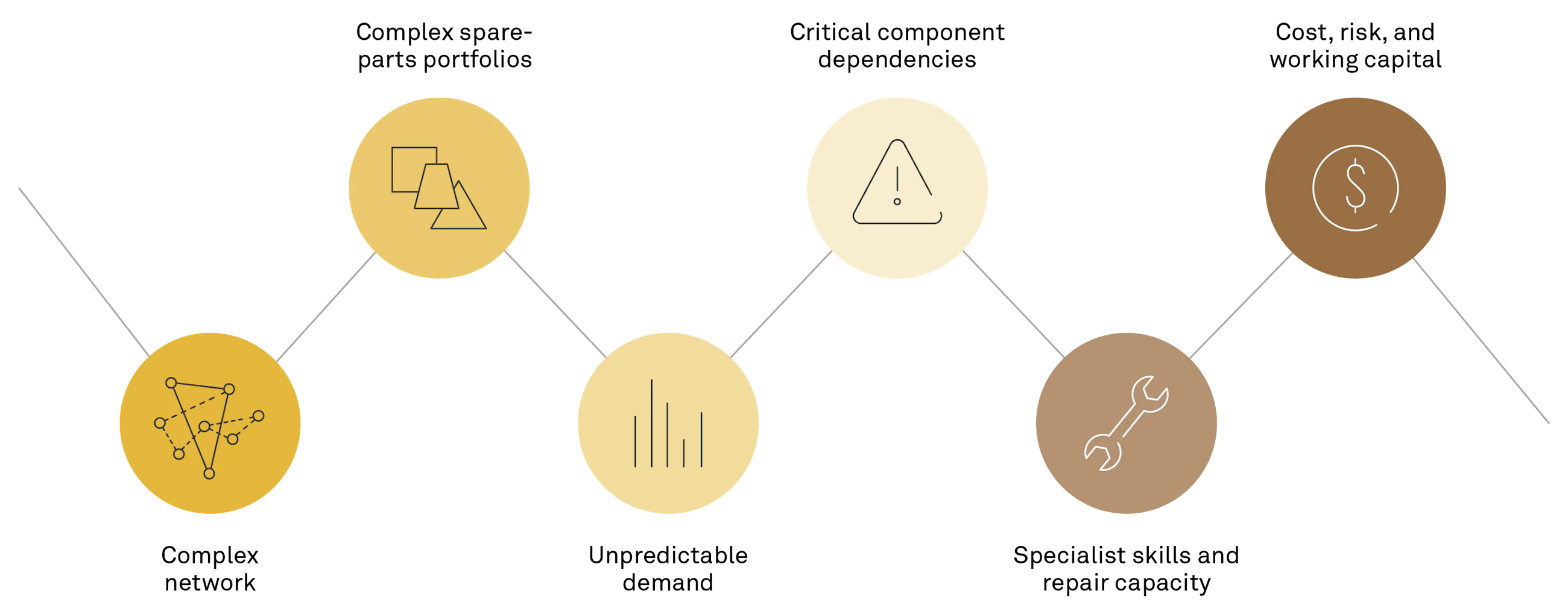
Delivering this consistently across modern defence organisations is considerably more complex. Large and specialised asset portfolios, uncertain operational demand, long lead times, critical dependencies, and fragmented supplier networks all shape the availability of equipment.
The core challenges
Fragmented supplier and maintenance networks
MRO spans operational units, national depots, OEMs, suppliers, and specialist repair providers, often across several countries. Limited end-to-end visibility can slow coordination, obscure dependencies, and make it difficult to respond quickly when priorities change.
Operational consequence: Delayed decisions and slower recovery of unavailable assets.
Complex spare-parts portfolios
Defence organisations manage thousands of low-volume and platform-specific components, many of which have long lifecycles and limited supplier options. Inventory decisions must balance readiness, obsolescence, working capital, and supply risk.
Operational consequence: Excess stock in some areas, while mission-critical components remain unavailable elsewhere.
Uncertain operational demand
Failures, changing missions, ageing equipment, and shifts in operational tempo create demand patterns that are difficult to forecast. Historical consumption alone may provide an incomplete basis for future planning.
Operational consequence: Reactive maintenance and supply decisions, with limited ability to anticipate emerging constraints.
Critical component dependencies
A relatively small or inexpensive component can determine the availability of an entire platform. Traditional inventory priorities do not always reflect the operational effect of individual shortages.
Operational consequence: A disproportionate effect on readiness from a limited number of missing parts.
Long and uncertain lead times
Specialist production, certification, export controls, and security requirements can extend replenishment and repair timelines. Limited supplier capacity can create further uncertainty.
Operational consequence: Greater exposure to disruption and an increased need for forward planning.
Specialist skills and repair capacity
Readiness depends on technicians, engineers, planners, and other specialists with platform-specific knowledge. These capabilities are often scarce and cannot be expanded quickly.
Operational consequence: Equipment can remain unavailable even when parts, facilities, and funding are in place.
What this means in practice
Most defence organisations recognise these challenges. The greater difficulty lies in coordinating decisions across maintenance, supply, engineering, and operations while scaling MRO capabilities to support growing fleets and increasingly complex supply chains.
Today, different parts of the organisation often optimise for their own objectives. Maintenance planning, inventory management, supply planning, and operational priorities may all be managed effectively in isolation, but readiness depends on how well these decisions work together.
MRO is often managed in silos:
- Maintenance planning optimises locally
- Supply planning reacts to demand
- Inventory decisions are disconnected from operational priorities
This leads to:
- Overstocks of non-critical parts
- Shortages of mission-critical components
- Poor transparency on trade-offs between cost, risk, and readiness
Turning MRO into an integrated readiness capability
Improving readiness requires more than additional inventory or repair capacity. Organisations need to connect planning, data, suppliers, engineering, and operations around a shared understanding of operational priorities.
Four capabilities are particularly important.

Why this matters now
Europe’s defence build-up is increasing demand for maintenance, specialist skills, spare parts, and industrial capacity. As fleets expand, organisations that coordinate these capabilities effectively will be better positioned to sustain operational readiness over time.
Expanding procurement without strengthening the systems that support equipment throughout its lifecycle risks creating additional pressure rather than additional capability. MRO therefore needs to evolve alongside procurement, industrial production, and operational planning.
The bottom line
As Europe increases defence investment, the ability to sustain operational readiness will become increasingly important. New platforms, larger fleets, and higher operational demands will place additional pressure on maintenance organisations, supply chains, repair capacity, technical skills, and lifecycle data.
MRO therefore needs to be managed as an integrated readiness capability. This means connecting maintenance, supply, engineering, operations, data, and external partners around a shared view of priorities, constraints, and risk.
At Implement, we help organisations strengthen these connections across planning, supply chain, operating models, data, and operational excellence. Our experience spans defence, aerospace, rail, and other asset-intensive environments where availability, resilience, and cost transparency depend on effective coordination across the full lifecycle.
The following questions can help organisations assess where their current MRO setup is strong, and where further work may be needed.
Readiness checklist
✓ Do maintenance, supply, inventory, engineering, and operational teams work from the same priorities?
✓ Can you identify which spare parts and components create the greatest readiness risk?
✓ Do you have sufficient visibility across supplier capacity, repair lead times, and critical dependencies?
✓ Are specialist skills and repair capabilities available where and when they are needed?
✓ Can you explain the trade-offs between inventory cost, supply risk, and operational readiness?
✓ Are MRO and lifecycle requirements considered early enough in acquisition and capability planning?
Reach out to our defence and security experts 10
Related0 4
Article
Read more

Operational readiness in European defence
As Europe accelerates its defence build-up, operational readiness is becoming a central strategic priority.Article
Read more

AI in defence and security
Defence and security organisations need AI that works under pressure - with control, trust and accountability.Article
Read more