Article
Turning capital into industrial capability in the Danish defence sector
Published
17 August 2026
State of investing in defence in Denmark
The background
Denmark is entering a sustained defence build-up, supported by rising public funding, stronger political commitment, and growing demand for industrial capacity.
This creates opportunities across technology, manufacturing, supply chains, and lifecycle support. It also raises a more practical question: which companies can convert demand and capital into qualified, scalable, and reliable delivery?
The opportunity
The Danish supplier base includes established defence companies, engineering-led SMEs, and dual-use specialists with strong capabilities in areas such as maritime systems, sensors, communications, cyber, and autonomous technologies.
Many of these companies have proven technologies and international potential. Their ability to scale will depend on production maturity, programme governance, compliance, quality assurance, supply-chain resilience, and access to the right commercial partnerships.
For investors, the opportunity lies in supporting that development with both capital and operational expertise.
The investment thesis
The central investment question is where industrial capability can mature fast enough to meet growing demand.
The strongest opportunities are likely to be companies that combine differentiated technology with the ability to qualify, produce, deliver, and support solutions at programme scale.
Capital can accelerate that development when it is combined with practical support across production systems, quality, compliance, cybersecurity, supplier management, and relationships with primes and tier 1 integrators.
Our perspective is that active ownership can help close the gap between technical potential and programme-ready execution.

The Danish defence industrial ecosystem
Denmark has a specialised and highly export-oriented defence industrial base. The ecosystem includes established defence companies, engineering-led SMEs, dual-use specialists, component suppliers, and technology businesses with capabilities across maritime systems, sensors, communications, cyber, software, and autonomous technologies.
A small group of established companies has already demonstrated the ability to deliver at international programme scale. Alongside them sits a broader group of specialist suppliers with strong technical capabilities and the potential to take on larger roles in European and international value chains. For many of these companies, the next stage of growth will depend on stronger production systems, quality assurance, compliance, supply-chain resilience, and relationships with primes and tier 1 integrators.
Investment activity has increased as defence budgets have grown and European supply chains have come under pressure. Since 2023, the Danish market has seen a rising number of defence-related transactions, reflecting both broader European consolidation and growing interest in specialist technologies, industrial capacity, and lifecycle services.
Nordic defence transactions – 2023-2026 ytd1

Denmark’s opportunity lies in scaling specialist capability into reliable programme delivery.
Capital is committed
The question is how effectively it can be converted into industrial capability
Denmark has made a substantial and long-term financial commitment to defence.
With statements of March 2024 and February 2025, Denmark plans to spend 2.3% of GDP on defence by 2033, however peaking at 3.4% in 2025. Denmark’s total defence economic framework runs to DKK 357.5 billion through 2033, comprising the baseline Defence Agreement of DKK 194.7 billion, the Acceleration Fund of DKK 120 billion, and an additional DKK 42.7 billion agreed in October 2025.2
For investors, the availability of capital is therefore only part of the picture. The more important question is whether companies can absorb demand, strengthen their production and delivery systems, and build the capabilities required to operate at programme scale.
This places industrial execution at the centre of the investment case.
Development in the nordic defence budgets
bnEUR3, 2021-2028 Actuals, Estimates, and Forecasts4
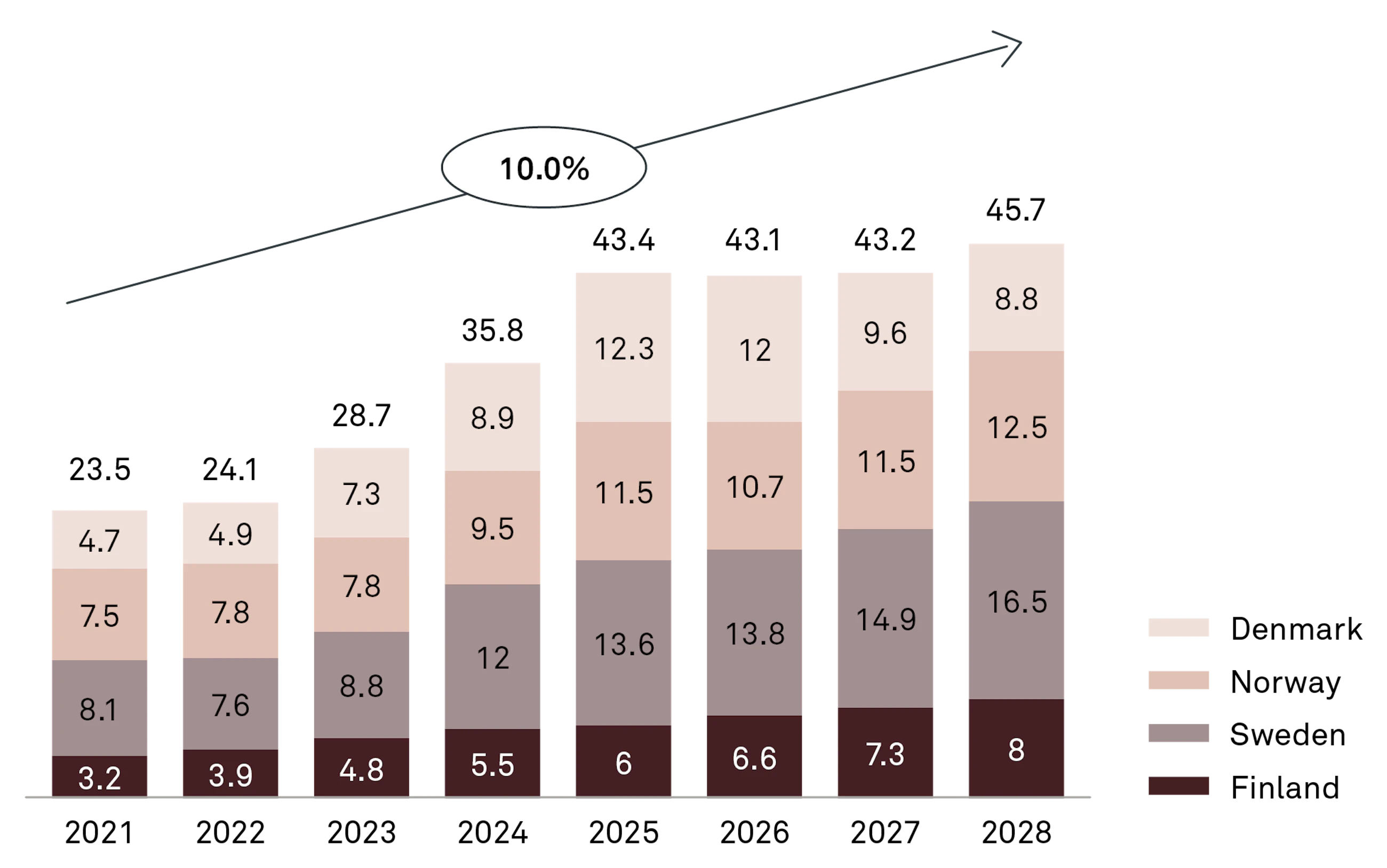
Capital creates opportunity when companies can convert it into qualified, scalable, and reliable delivery.
Scaling defence businesses requires more than capital Capital is becoming more readily available across the European defence sector. The greater challenge is whether companies can scale from specialist suppliers to reliable programme partners. That transition depends on six capabilities.
- Procurement and programme cycles. Government procurement often involves long and uncertain timelines. Danish SMEs need sufficient financial resilience to navigate extended sales cycles, shifting priorities, and delayed contract awards.
- Route-to-market. Many Danish companies will need to build trusted relationships with primes, tier 1 integrators, and international programme partners rather than sell directly to defence customers. Market access therefore depends on certifications, partnerships, and the ability to integrate into established value chains.
- Operational scalability. Strong engineering capabilities must be matched by production systems, quality management, governance, and operational processes that support reliable delivery at programme scale.
- Compliance and security. Export controls, cybersecurity, quality assurance, and security requirements shape both market access and delivery. These capabilities need to be built into the business early and developed as the company grows.
- Supply chain resilience. Many specialist suppliers depend on limited production capacity, specialised components, or geographically concentrated suppliers. Growth therefore requires stronger supplier relationships, better visibility, and active management of critical dependencies.
- Capital and public funding. Private capital can support growth, but public funding, export finance, and European programmes will often form part of the wider financing model. Companies that combine these sources of capital with strong operational execution will be better positioned to scale sustainably.
Bridging the gap as an investor:
The strategic role of active ownership in the Danish defence sector
The opportunity
The Danish defence sector combines strong engineering capabilities with growing demand across Europe.
Many companies have developed highly specialised technologies and occupy attractive positions in international value chains.
The next stage of growth will depend on their ability to strengthen production systems, quality assurance, compliance, supplier management, and programme governance alongside continued technology development.
The role of active ownership
Scaling defence businesses requires more than financial investment.
Active owners can help strengthen operational capabilities, support management teams, develop supplier ecosystems, and build the governance required for larger and more complex programmes.
This combination of capital and operational expertise can help companies scale more effectively while strengthening their position within the wider defence ecosystem.
Why timing matters
European defence spending is increasing, procurement pipelines are expanding, and industrial partnerships are becoming increasingly important.
Companies that strengthen their operational capabilities today will be better placed to participate in future programmes and sustain long-term growth.
Our perspective
Our perspective is that capital creates the greatest value when it strengthens industrial capability.
Investors who combine financial resources with operational expertise and a long-term commitment to building resilient businesses will be better positioned to support sustainable growth.
The following section explores four investment themes that illustrate where these opportunities may emerge.
Investment themes
We believe these four themes illustrate where long-term opportunities are emerging across the Danish defence ecosystem.

- Dual-use technology
Technologies with both civilian and defence applications can access larger addressable markets while supporting innovation across sectors. Many Danish companies have strong capabilities in software, autonomy, sensors, and advanced engineering that can be adapted for defence use.
As European investment increases, companies with proven dual-use technologies and scalable business models are well placed to support future capability development. - Navy supply
Growing investment in naval capabilities is increasing demand across shipbuilding, maintenance, specialist components, and maritime systems. Opportunities extend well beyond prime contractors to suppliers with differentiated products and services.
Companies that combine technical expertise with reliable programme delivery are likely to benefit from sustained investment in European naval capability. - Cybersecurity
Cybersecurity remains a strategic priority across European defence. Demand continues to grow for secure software, resilient communications, digital infrastructure, and technologies that strengthen operational resilience.
The sector combines long-term structural demand with strong opportunities for companies capable of delivering trusted and scalable solutions. - Basic defence supplies
Recent geopolitical developments have highlighted the importance of resilient defence supply chains. Capacity, specialist manufacturing, logistics, repair capability, and critical components are all becoming strategic priorities.
Companies that strengthen resilience across the defence industrial base are likely to play an increasingly important role as European production scales.
1. Dual-use technology
Dual-use technologies serve both civilian and defence markets, giving companies access to broader markets, faster innovation cycles, and established commercial applications.
Denmark has relevant capabilities across autonomy, sensors, communications, software, and advanced engineering. The strongest investment opportunities are likely to be companies with proven technology, a credible route into defence programmes, and the operational capacity to scale.
What makes the theme investable
Dual-use technology can develop in two directions.
Civilian technology adapted for defence
Technologies developed for commercial markets may be adapted to defence requirements. Examples include autonomous systems, secure communications, sensors, and software for logistics, planning, and data analysis.
These companies may benefit from established products, existing customers, and faster commercial development cycles. Defence growth will depend on their ability to meet additional requirements for security, compliance, reliability, and integration.
Defence technology with civilian applications
Technologies developed for defence can also create value in areas such as emergency response, critical infrastructure, industrial automation, and public safety.
The investment case is strongest where the underlying technology is differentiated and the company can serve several markets without weakening its focus or operating model.
Selected Danish Companies
- Nordic Wing
Develops fixed-wing unmanned aircraft systems for defence and security applications. The company illustrates the potential in specialised autonomous platforms. - MyDefence
Develops counter-drone technology for military operations and the protection of critical infrastructure and other high-security environments. - UXV Technologies
Develops components and systems for unmanned and remote-controlled platforms, including payloads, control stations, sensors, and electronic hardware. - Systematic
Develops software that supports the use of complex information in defence, security, and other critical environments.
2. Navy supply
Investment in European naval capability is increasing demand across shipbuilding, maintenance, specialist components, and maritime systems.
The opportunity extends beyond major vessel programmes. It also includes suppliers that can improve production capacity, strengthen fragmented value chains, and support vessels throughout long operational lifecycles.
What makes the theme investable
Within navy supply, there are certain areas of high relevance for future investments.
Capacity and productivity
European naval programmes are increasing demand for shipbuilding capacity, equipment, and specialist services. After decades of relatively low volumes, parts of the industrial base require modernisation, additional capacity, and more productive delivery models.
Supply chains and specialist equipment
Naval supply chains include a broad network of smaller companies providing components, systems, engineering, and services. This fragmentation creates opportunities for consolidation, stronger supplier coordination, and investment in differentiated equipment.
MRO and lifecycle services
Naval vessels remain in service for decades and require continuous maintenance, repair, upgrades, and technical support. Growing fleets and extended platform lifecycles are likely to increase demand for MRO capacity and lifecycle services.
Selected Danish companies
- Danske Flådeskibe
A Danish maritime consortium comprising Semco Maritime, OMT, and Terma. The consortium brings together capabilities across vessel design, construction, systems, and lifecycle support. - Naval support vessel consortium
A consortium comprising Karstensens Skibsværft, Hvide Sande Shipyard, and OSK Design. The collaboration combines shipbuilding, design, and maritime equipment capabilities relevant to future naval support vessels.
3. Cybersecurity
Cybersecurity is becoming an increasingly important area of investment across European defence. Digital resilience, secure communications, intelligence, and critical infrastructure protection are all growing priorities as defence organisations become more connected and data-driven.
The strongest opportunities are likely to be companies that combine trusted technologies with capabilities that support operational resilience and secure decision-making in practice.
Looking closer at the investment theme
Within cybersecurity, there are certain areas of high relevance for future investments.
Critical infrastructure protection
Modern defence capabilities depend on resilient digital infrastructure, including energy systems, communications, navigation, and operational technology. This creates demand for solutions that strengthen the resilience and security of critical infrastructure.
Secure military and government communications
Military operations rely on trusted communications, secure data exchange, and resilient command-and-control systems. As digital dependence grows, so does the need for technologies that support secure communications across military and government organisations.
Threat intelligence and cyber operations
The growing complexity of cyber threats is increasing demand for technologies that support threat intelligence, network monitoring, incident detection, and cyber operations..
Selected Danish companies
- LOGPOINT
Develops security information and event management (SIEM) and network detection and response (NDR) solutions that support organisations in identifying and responding to cyber threats.
4. Basic defence suppliers
Recent geopolitical developments have highlighted vulnerabilities in European production capacity and supply chains for essential defence equipment.
This creates investment opportunities in companies that strengthen industrial resilience through specialist manufacturing, critical materials, logistics, protective equipment, and more reliable supply.
Looking closer at the investment theme
Within basic defence suppliers, there are certain areas of high relevance for future investments.
Ammunition and ground equipment
Demand for ammunition and ground equipment has increased as European countries replenish stockpiles, expand training activity, and strengthen national readiness.
The investment opportunity extends beyond final assembly. It includes production capacity, specialist components, raw materials, equipment modernisation, and more resilient supply chains.
Companies that can improve capacity, security of supply, and production efficiency are likely to become increasingly important as demand grows.
Advanced textiles and protective equipment
Demand is growing for lighter, more ergonomic, and more multifunctional protective equipment. This includes advanced materials, smart textiles, wearable technologies, and specialised protective systems.
The strongest opportunities are likely to be companies that combine materials innovation with reliable production, certification, and the ability to serve defence and adjacent markets.
Selected Danish companies
- PGD
Develops and manufactures protective equipment, including body armour, helmets, and related personal protection products.
Turning investment into industrial capability
Capital is one part of the equation. Turning investment into industrial capability requires organisations, production systems, supply chains, governance, and partnerships that can deliver reliably at programme scale.
Implement works with companies and public organisations across the defence ecosystem to strengthen operational performance, industrial capability, and long-term resilience. Our experience spans strategy, operations, supply chains, transformation, and implementation across complex and highly regulated industries.
We combine industrial expertise with practical experience from defence, aerospace, manufacturing, infrastructure, and the public sector to help organisations turn ambition into execution.
Sources
1. The numbers are given by the Confederation of Danish Industry on defence, the AFDA Association, the FSI (Norwegian Defence and Security Association 2024), and the SOFF (Swedish Security and Defence Association 2024).
2. Cf. the Danish Ministry of Defence - https://www.fmn.dk/en/topics/a...
3. The current prices and exchange rates have been utilised.
4. The numbers for 2021-24 are based on NATO’s defence expenditure publications from April, 2025. The growth rates for 2025-2028 are calculated based on governmental announcements and national budget plans from Q4, 2024 to Q2, 2025 using relative future increases, cf. NATO, Regjeringen (NO), and Regeringen (SE).
Reach out to our defence and security experts 10
Related0 4
Article
Read more

Operational readiness in European defence
As Europe accelerates its defence build-up, operational readiness is becoming a central strategic priority.Article
Read more

AI in defence and security
Defence and security organisations need AI that works under pressure - with control, trust and accountability.Article
Read more