Article
Published
18 August 2026
Three forms of AI – and what they require in defence
Traditional AI: Uses structured data to identify patterns, support forecasting, and optimise decisions. In defence, it can support areas such as maintenance planning, logistics, risk sensing, and resource allocation.
Generative AI: Works with text, images, and other unstructured information. It can support search, document analysis, reporting, and knowledge work when used in secure and well-governed environments.
Agentic AI: Combines language models with controlled access to tools and systems to carry out multi-step tasks. Its use requires clear boundaries, defined accountability, and human control.
The more autonomous the system, the more important governance, human oversight, and operational accountability become.
AI matters when it delivers in operations
Defence organisations are under growing pressure to acquire, field, and sustain new capabilities at pace.
AI can improve how data is used, reduce avoidable friction, and help people make more informed decisions.
Its value depends on how well it fits operational needs, security requirements, existing systems, and the people responsible for using it.
AI is becoming part of defence capability
AI is already being applied across defence and security, from document analysis and staff support to cyber, procurement, maintenance, and planning.
Defence organisations are building these capabilities in different ways and at different speeds. The common task is to move from promising applications to solutions that can be used securely, reliably, and with clear accountability in operations.
Where AI is already being applied
- Document analysis and retrieval
- Staff support
- Cyber analysis
- Procurement support
- Maintenance and availability
- Planning and simulation
What makes it operationally useful
- Usable data
- Secure environments
- Integration with existing systems
- Clear ownership
- Human oversight
- Skills and adoption
AI can create value when it helps strengthen readiness, supports informed judgement, and works reliably in operations.
From pilots to operational use
AI is being explored across defence, from document analysis and staff support to cyber, procurement, maintenance, and planning.
The next task is to bring the most useful applications into everyday work without compromising security, accountability, or operational control.
What shapes the path to scale

Scaling AI means building the conditions for operational use
- Secure access
- Usable data
- Clear ownership
- Continuous learning
What shapes the path to scale The aim is not more pilots; it is AI that can be used reliably in operations.
Where AI can support defence capability
AI is already being applied across defence and security in a number of practical areas. The most useful use cases start with a clear operational problem and can be introduced where the right security, data, and governance conditions are in place.
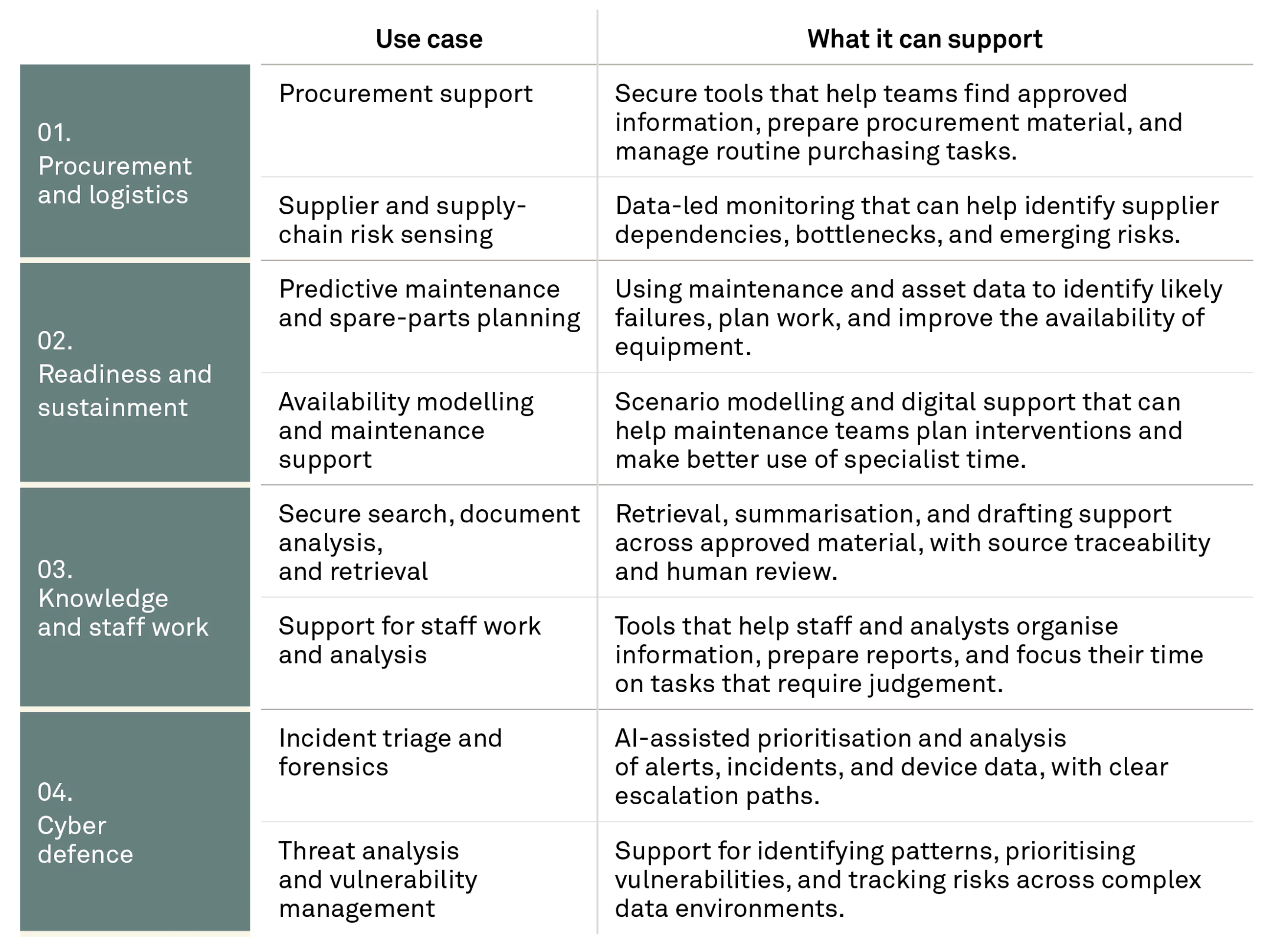
Some use cases are ready for controlled deployment today. Others depend on further work on data, integration, security, and operating models.
Selected AI use cases in defence and security
AI can support defence capability in a number of practical areas. The strongest use cases address clear operational needs and can be introduced within secure, well-governed operating conditions.

The most useful starting points are clear operational problems, available data, and the conditions needed to use AI reliably.
Selected examples
These examples show how Implement has helped clients apply AI in regulated and asset-heavy environments. They illustrate several of the conditions that also matter in defence and security: trusted data, operational ownership, human oversight, and the ability to integrate new tools into existing work.
AI-supported regulatory compliance
Regulated environment // Human oversight
A client in a highly regulated industry needed a faster and more consistent way to assess frequent regulatory changes across jurisdictions.
We designed a generative AI workflow that screens updates, identifies relevant changes, and supports human review.
Impact
- 50% faster regulatory review processes
- 50%+ reduction in early compliance labour costs
- Improved consistency and a more proactive compliance approach
Predictive maintenance for heavy marine assets
Equipment availability // Predictive maintenance
Working with engineering and data-science specialists, we tested purpose-built sensors, established a reliable data pipeline, and developed an AI model to predict lubrication-related failure risks in large marine engines.
The work created a feasible route towards an onboard predictive maintenance model.
Impact
- Purpose-built sensors validated in the target machinery environment
- Reliable, continuous data pipeline
- Sensor data transformed into AI-ready features
- A feasible route towards an onboard predictive model
Different contexts. Similar conditions for operational use.
Five strategic choices for AI readiness
AI readiness depends on the choices organisations make about purpose, scale, ownership, sourcing, and operating model.

There are no universal answers. What matters is making the key choices explicit, understanding the trade-offs, and revisiting them as operational needs evolve.
Future outlook
Near term: Build confidence through practical use
AI can support document analysis, procurement support, and staff work in secure environments. These applications can improve access to approved information, reduce repeatable manual work, and help organisations build confidence in how AI is used.
Medium term: Scale secure operational use
Predictive maintenance, supply-chain risk sensing, and AI in classified environments require more than an individual use case. They depend on reliable data, secure infrastructure, clear ownership, and the ability to integrate new tools into daily operations.
Long term: Strengthen readiness and decision support
AI is likely to play a growing role in sensing, analysis, planning, and decision support. Its value will depend on whether organisations can retain human judgement, clear accountability, and operational control as use becomes more consequential.
The organisations that build these foundations now will be better placed to use AI where it can make a practical difference to readiness.
Reach out to our experts0 4
0
4Related0 4
Article
Read more

Operational readiness in European defence
As Europe accelerates its defence build-up, operational readiness is becoming a central strategic priority.Article
Read more

Readiness lives after acquisition
Why maintenance, repair, and overhaul (MRO) have become a strategic capability in European defence.Article
Read more