Article
A combination of top-down commitment and bottom-up activation

Article for Handelszeitung
This text was first published in German in the marketing supplement of the renowned business paper Handelszeitung.
Published
3 December 2025
Customer centricity is not a project. It is an attitude. And today, more than ever, it is a strategic imperative. Any CEO or CMO who still believes that customer centricity is primarily the responsibility of marketing and sales is misjudging the reality. In a world where consumers are increasingly informed, connected, and demanding, customer centricity must become part of the DNA of the entire company.
Change is a mindset
Customer centricity is first and foremost a question of mindset. It is about considering the customer's perspective in every decision, both strategic and operational. While that may sound simple, it actually poses a challenge to most of us because it means questioning familiar patterns of thinking, breaking down silos, and redistributing responsibility.
A key principle is to always ask: "How does this decision serve our customers?" When this question becomes second nature – all the way from product design and pricing to internal process optimisation – your organisation is on its way to a mindset change.
The CMO as the spearhead of cultural change
The CMO plays a key role in this change. Not as the sole driver, but as an ambassador for the customer perspective. The modern CMO is not only responsible for the brand, but also the architect of the customer experience, bringing the voice of the customer to all areas from HR to innovation to production.
This should not end up in more meetings, but more impact. The CMO must inspire, connect, and empower. This means that he or she must show what customer centricity looks like in concrete terms – and, just as importantly, how it feels.
Top-down AND bottom-up
Customer centricity cannot be imposed. It must be experienced. And getting to that point requires a combination of top-down commitment and bottom-up activation.
Top-down commitment means that management demonstrates customer centricity in its daily activities. The customer perspective is consistently incorporated into town hall meetings, management meetings, and internal updates: instead of just talking about costs or products, the key question must be: "What customer problem are we solving here?"
Managers show their presence at customer feedback sessions or consciously pick up on customer voices in strategy meetings. They also create space for experimentation by allocating budgets for pilot projects that focus not on ROI but on learning new insights about customers. And they make progress visible: improved NPS scores or new feedback processes are celebrated just as much as increases in revenue. In this way, customer centricity is not only demanded by management but also exemplified.
Bottom-up activation means that employees become co-creators. Through hackathons, small pilot projects, and peer groups, they develop new ideas, test new behaviours, and share their experiences. Not surprisingly, data plays an increasingly important role in this process: teams use customer feedback, usage data, and AI-supported analyses to develop hypotheses and make better decisions. This is because customer behaviour and needs are changing faster than ever before – varying by segment, region, and often by situation.
A granular, data-informed view helps to identify these dynamics early on and respond to them in a targeted manner. When employees see that their ideas and experiments – supported by the new possibilities offered by data and AI – are having an impact, a movement emerges that goes far beyond individual programmes.
What it takes in practice
From our work with international companies, we can conclude that customer centricity succeeds when four elements come together:
- Mindset & behaviour: Change begins with small, concrete steps. Teams try out new behaviours, reflect, and learn.
- Structures & systems: Only when the new way of thinking is established do adjustments in organisation, governance, and KPIs follow.
- Ambassadors & communities: Committed employees become multipliers. They inspire others and keep the energy high.
- Measurability & communication: Progress is made visible. Successes are celebrated. Pilot projects are shared.
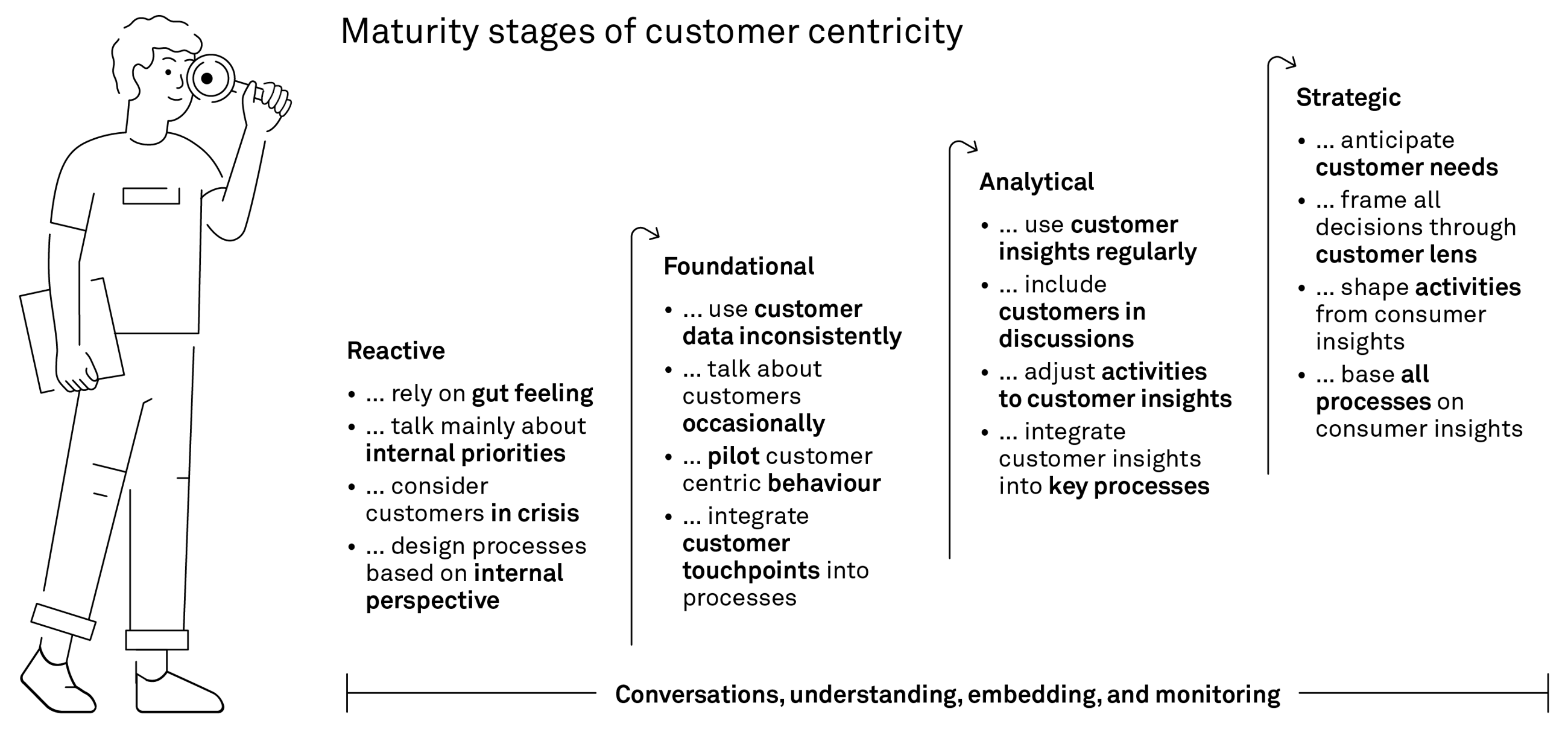
The business case is clear
Customer centricity is not just a cultural change – it also makes economic sense. Reputable studies show that customer-centric companies are up to 60% more profitable than those that do not consistently focus on their customers. They grow faster, retain their customers for longer, and are more resilient in times of crisis.
Making customer centricity measurable is about counting the right KPIs. To ensure that customer centricity does not remain merely a cultural ideal but can actually be managed in a targeted manner, you need clear key performance indicators.
Three KPI dimensions have proven effective:
- Organisational commitment, for example through the number of participants in customer-oriented programmes or the number of active ambassadors.
- Behaviour and processes, measured, among other things, through pilot projects and maturity analyses.
- Business impact, for example through price premiums, innovation rates, and time-to-market. These three KPIs help make progress visible – and customer centricity manageable.
For CMOs and CEOs, now is the time to move forward while remembering that true customer centricity is a journey, not a destination. Big words will not get you there; one small, courageous step after another will. And it will be worth it. Because consistently customer-centric companies prove more innovative, more relevant, and, ultimately, more successful.
Want to know more?
Reach out to one of our customer centricity experts:
Related0 4
Article
Read more

AI in grocery retail
Grocery retailers can use AI to improve decisions, margins and customer relevance.Article
Read more

The synthetic market as competitive infrastructure
How AI-powered simulations are redefining commercial strategy.Article
Read more