Case
How Visma e-conomic built and launched a new AI offering in just five months


Article
Read more
22 May 2026
Visma e-conomic wanted to continue growing at around 20%, and one of their key bets was on AI. Since they did not already have an AI product, the capabilities to build one, or a clear path to market, the starting point was simple, and the question straightforward: How do we build something that actually supports growth?
As the work progressed, it became clear that this was not just a product question. Visma e-conomic saw competitors moving and new AI-first players entering the market, while the team also began to understand how far the technology had come.
In developing the product, they began to realise just how transformative the technology would become for their industry. With the right setup, whatever task they gave the AI models, the models consistently outperformed expectations.
That shifted the perspective from building an AI product to understanding what this could – or indeed would – mean for the industry and the value chain they are part of.
Building the solution meant exactly that: from day one, the work had to be set up as a build.
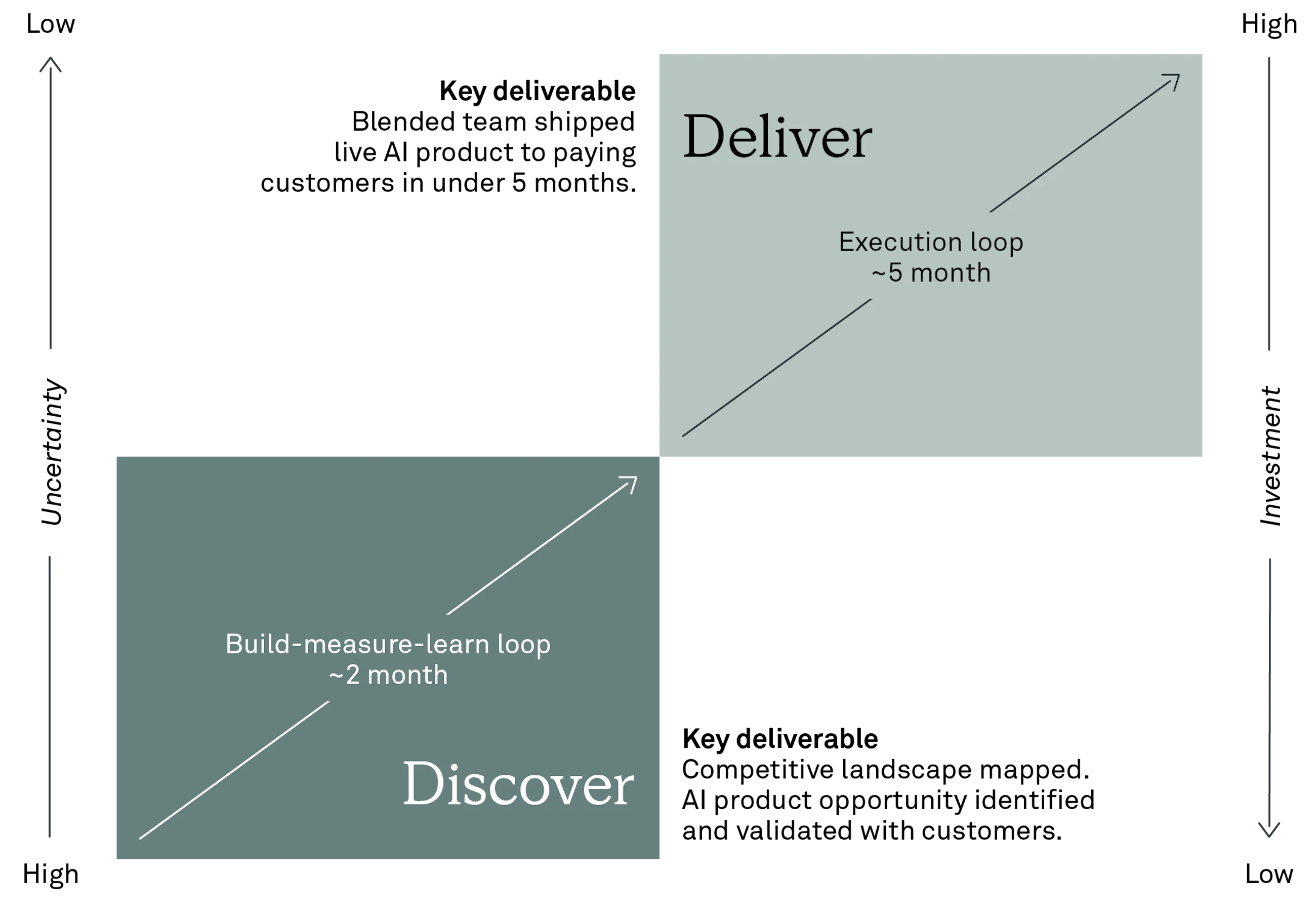
A joint team from Implement and forward-deployed engineers from The Tech Collective worked embedded at Visma e-conomic, directly in their systems, data, and codebase. This meant that product discovery, development, and go-to-market could happen in parallel rather than as handovers between phases.
Technically, the solution was built as an agentic setup on the Google stack, using frontier Gemini models orchestrated through specialised agents and integrated directly into Visma e-conomic’s platform.
At a high level, the system:
This represents a notable shift. In practice, it functions as a financial advisory assistant that helps accountants work with better data and preparation, rather than replacing their role.
Before AI, much of Visma e-conomic’s work was manual, as month-end closing, transaction checks, and report preparation have always been. Each customer setup required interpretation, and a significant part of the effort went into making the data usable.
With the solution in place, much of that work can be handled by the system. The data is now structured, issues are surfaced, insights are prepared, and the best part is that all three elements free up time for interpretation and advisory.
In just five months, Visma e-conomic moved from an idea to a product in the market – not just in the form of a pilot, but an actual commercial offering with real functionality, a defined pricing model, and customers who can use it.
Christian Wook Andersen, Chief Product Officer, Visma e-conomic
More importantly, it adds something that was not there before – a new product and a new source of revenue.
Visma e-conomic’s original question was simple: how can AI support our growth? But along the way, the process also showed how much of the existing work could be done differently, and what that means for Visma e-conomic going forward.


