Article
... and why your forecast is wrong when lead times exceed tender response times

Book
Read more
27 April 2026
In many industries, tender business plays a decisive role but nowhere more so than in life sciences and pharma. Large tenders can determine capacity utilisation, inventory levels, service performance, and ultimately profitability for years ahead. Yet despite their strategic importance, tenders are still handled with surprisingly little rigour in most planning processes.
In many organisations, tender volumes are simply ‘probability‑adjusted’ and fed into the demand forecast as if they were just another source of demand. A 50% win probability becomes 50% of the volume. On paper, this looks reasonable. In practice, however, it is often dangerously misleading.
The core issue is not data quality or forecasting skill. It is a fundamental mismatch between how tenders behave and how planning processes are designed to work.
At the heart of the problem lies a simple reality: tenders are binary. You either win 100% of the volume, or you win nothing.
This may sound obvious, yet many planning processes implicitly treat tenders as if they were continuous demand streams. Probability‑weighted volumes create an illusion of precision, but they do not reflect operational reality. You never produce or ship 50% of a tender. You either need full capacity and material readiness – or you need none of it.
This binary nature becomes especially problematic when tender volumes are large relative to the production footprint. In pharma, a single tender can represent an entire production campaign, a full shift, or a meaningful share of annual volume for a product family. Similar patterns appear in private‑label FMCG, process industries, and capital‑intensive manufacturing.
When such tenders are ‘smoothed’ into a forecast, the result is not risk mitigation but risk concealment.
The challenge is further amplified by long lead times. In many pharma supply chains, critical decisions on API, drug substance, and even drug product must be made long before the tender outcome is known. Production or procurement often has to start months, sometimes more than a year, before the official award.
This creates a structural dilemma:
Classical demand planning offers little help here. Forecast accuracy metrics, consensus meetings, and incremental forecast adjustments cannot resolve a situation where the confirmation simply arrives too late.
When lead time exceeds tender response time, forecast accuracy ceases to be the issue. The forecast concept itself breaks down.
Many organisations respond by adding scenarios. Best case, worst case, most likely. While well‑intended, this often leads to scenario inflation.
Too many tenders, too many combinations, too many hypothetical futures – and suddenly S&OP or IBP becomes overwhelmed. Planners lose clarity on which scenarios actually matter, executives lose confidence in the process, and decision‑making slows down.
Enough scenarios, what is missing is a clear logic for when and how tenders should be handled differently.
The key insight is this: Not all tenders should be planned in the same way.
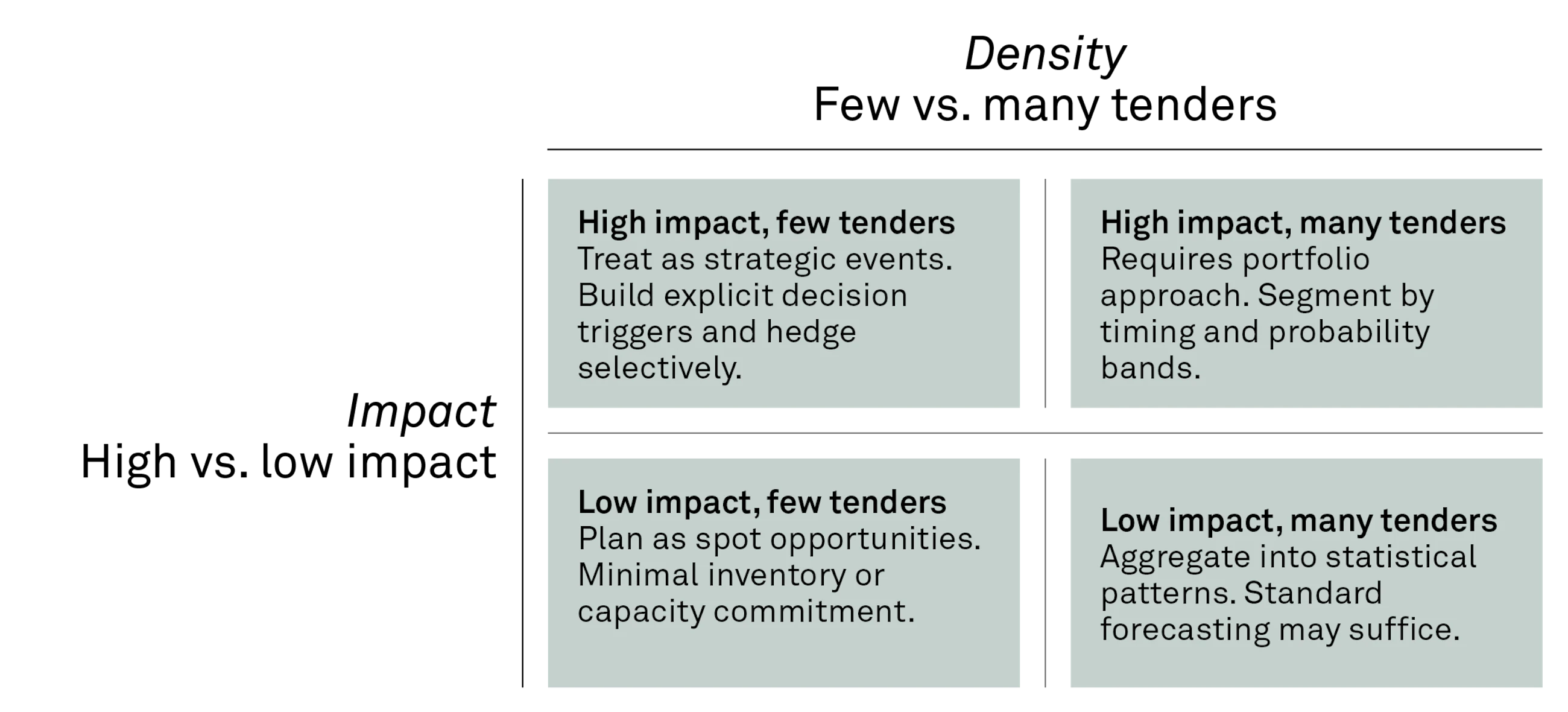
Instead of forcing tenders into a single forecasting logic, they need to be segmented based on two fundamental dimensions:
Together, these dimensions form a simple 2×2 matrix that acts as a decision framework for tender planning and risk management.
This is not a mathematical model; it is a governance model.
The life sciences industry is under pressure to innovate faster and operate smarter. We support clients in rethinking their operating models, enabling stronger collaboration across the value chain and delivering the transformations needed to bring innovative therapies to market efficiently.
The tender forecasting matrix distinguishes between four fundamentally different situations:
The power of the matrix lies in what it prevents: applying the same forecasting logic everywhere.
When impact is high, uncertainty typically is too, and that combination calls for scenario planning, not point forecasts. But this is exactly where many organisations lose control: too many scenarios, or scenarios that don't map to a clear decision. The result is analysis without action. What's needed instead is a structured process that limits the number of scenarios while keeping them tied to real decision options.
For High impact, few tenders, this is straightforward: build the win/loss scenario explicitly for each tender, since each carries enough weight to warrant individual attention.
For High impact, many tenders, the temptation is to model every combination. The better approach is to build a handful of scenarios anchored in the main drivers, defining a plausible high and plausible low outcome rather than an exhaustive set. This is what keeps scenario planning from becoming scenario inflation, and it is where judgment, not additional modelling, does the real work.
One of the most common – and costly – mistakes in tender planning is applying win probabilities at the wrong level of granularity.
When probabilities are pushed down to SKU or finished‑goods variant level, organisations end up planning ‘half production runs’ across multiple variants. The result is inefficient campaigns, excess inventory, and capital tied up in stock that may never move.
A more robust approach is to plan probabilistically at a higher level – such as drug product – and delay final packaging or configuration until the tender outcome is known. Postponement is a manufacturing strategy, but it is certainly also a sound risk‑management mechanism. And this shift alone can dramatically reduce both inventory risk and operational complexity.
One common reaction to the limitations of tender forecasting is to question whether win probabilities should be used at all. The answer is yes, but not where they are most commonly applied.
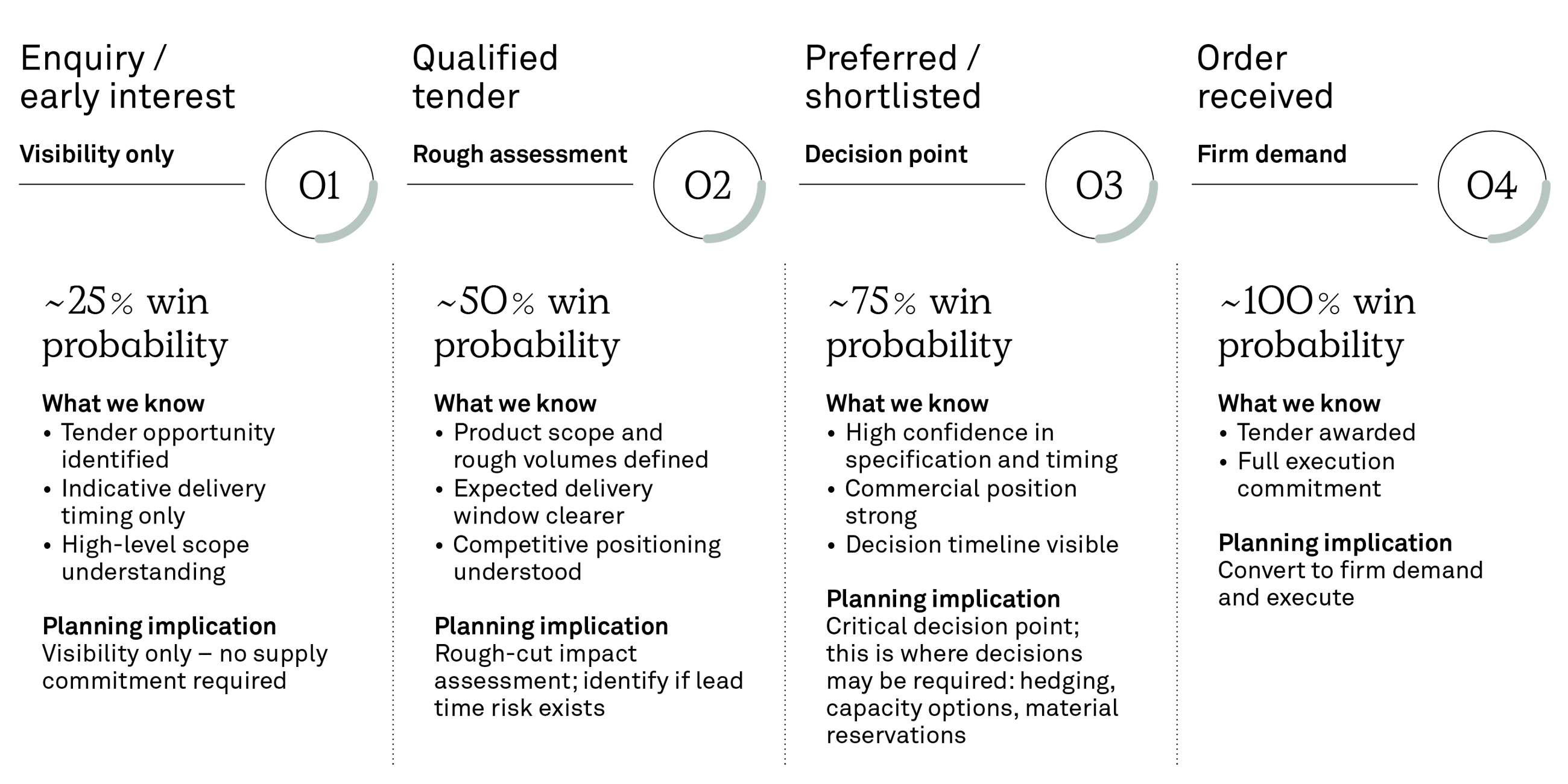
Probabilities do not belong in the demand forecast as a simple volume multiplier. They do belong in the sales funnel, as a way to structure confidence, timing, and decision‑making.
A pragmatic tender funnel typically moves through four stages:
The purpose of the funnel is not to predict outcomes, but to trigger the right decisions at the right time. As tenders mature, probabilities justify when waiting becomes more expensive than acting – especially when expected delivery falls inside the supply lead time.
Used this way, probabilities become a governance tool rather than a forecasting shortcut. They help organisations decide when to act, not how much to believe.
Beyond planning logic, many organisations have opportunities to reduce the impact of uncertainty itself. Rather than fully committing to production or inventory, companies can selectively buy reaction time or prepare themselves for winning – at a known and bounded cost.
A few commonly used hedging levers illustrate the principle:
The important point is not to apply these levers universally, but to deploy them deliberately, aligned with tender segmentation. Hedging makes sense where impact is high and timing is critical – but not as a blanket response to all uncertainty.
Used correctly, these mechanisms shift the discussion away from “What do we think we will win?” toward “What level of readiness is worth paying for?”, a far more sound question.
For executives, the implication is clear: tender forecasting is fundamentally a strategic design choice. If tenders represent a significant share of volume or risk, then:
For planning leaders, the challenge now is to design a process that remains robust, even when predictions are wrong.
Tender forecasting is often underestimated because it looks like a forecasting problem. In reality, it is a structural planning problem. When lead times are longer than tender response times, traditional demand planning logic no longer applies. Probability‑weighted forecasts create false comfort and real risk.
A segmented, principle‑based approach – anchored in a simple 2×2 logic, supported by a disciplined sales funnel and selective hedging – allows organisations to manage uncertainty without overproducing, over‑planning, or overwhelming decision forums.
If your lead time is longer than your tender response time, your current forecast is wrong. The question shifts from whether to change it to how deliberately you choose to do so.


