Article
The rise of integrated business planning


Book
Read more
8 April 2026
Among the participants were representatives from Novo Nordisk, Danske Bank, Semler Gruppen, Lundbeck, Ascendis Pharma, Orifarm, Pandora, NKT, Toms, and G4S, reflecting the width of industries grappling with the same challenge. The following article builds on the insights and discussions from that day.
Most organisations know the symptoms long before they diagnose the disease: fragmented planning cycles, functional silos, inconsistent assumptions, and an ever-expanding network of Excel files attempting to hold it all together. Each functional area – Sales, Operations, Distribution, Finance – works diligently, yet independently, to produce its own version of ‘the plan.’
The result is predictable. There is no single, uniform outlook for the business. Teams spend countless hours gathering data, reconciling discrepancies, and debating whose numbers are ‘more correct.’ Bottom-up planning, especially when executed primarily in Excel, becomes a heroic but time-consuming task – one that drains capacity without necessarily improving insight. Instead of supporting decision-making, planning becomes a bottleneck.
This is precisely the gap integrated business planning (IBP) seeks to close.
Integrated business planning offers a structured and strategic way to overcome these deeply entrenched issues. At its core, IBP is about aligning the entire organisation on a single, coherent plan and a shared view of the future. Rather than having Sales forecast one thing, Operations plan for another, and Finance try to reconcile the differences, IBP creates a unified, end-to-end planning environment. The aspiration is simple but transformative: One plan. One set of assumptions. One shared understanding of what the business is trying to achieve and how.
This alignment stretches across the full value chain – Sales & Marketing, Manufacturing, Distribution, and Finance. When executed well, integrated business planning does not just synchronise processes; it synchronises the organisation’s priorities, decisions, and actions.
Organisations that succeed with IBP often experience a set of common benefits:
Instead of wrestling with spreadsheets, teams can focus on understanding risks, optimising resources, and making forward-looking decisions that support the company’s strategic agenda.
But integrated business planning is not a single initiative; it is a system. And to build it effectively, organisations must work across three essential dimensions:
IBP requires a strong process backbone. Clear governance, repeatable planning rhythms, and well-defined roles ensure that cross-functional alignment is not just an aspiration but a consistent, embedded practice. Process integration is the foundation upon which everything else rests.
Modern FP&A and enterprise planning platforms are now designed specifically to support integrated business planning. With data spread across a growing number of systems, proper technology becomes essential to consolidating information, enabling collaboration, and maintaining a unified outlook.
Add to this the rising role of AI – automating repetitive tasks, enhancing forecast quality, and expanding analytical possibilities – and it becomes clear that technology is a core enabler of IBP.
Even with strong processes and modern tools, integrated business planning only succeeds when people work differently.
Alignment requires shared purpose, cross-functional trust, and a collective understanding of how the organisation plans. Change happens when mindsets shift – when teams begin to see the plan not as ‘their function’s plan,’ but as the organisation’s plan.
If traditional planning challenges are easy to diagnose – fragmentation, Excel sprawl, inconsistent assumptions – the shift to integrated business planning is anything but easy to execute. The technical solution is rarely the real barrier. The true complexity lies in the change required across the organisation.
Most companies today have decades of ingrained planning habits baked into their functional silos. Sales builds ‘their’ forecast; Operations builds ‘their’ capacity plan; Finance reconciles the gaps; and each function defends its numbers. The result is predictable: multiple versions of the truth, a lack of shared assumptions, and an enormous amount of time spent reconciling rather than deciding. Moving away from this model requires not just new processes, but a fundamental rewiring of how teams think about planning.
This is where the real difficulty begins. Integrated business planning demands that functions let go of local ownership in favour of collective ownership. It requires that planning becomes an end-to-end exercise – anchored in one plan, one set of assumptions, and one shared outlook for the business. That may sound simple in principle, but in practice it challenges longstanding behaviours, power dynamics, and decision rights that have often been in place for years.
As a result, the change management effort is substantial. IBP only works when Sales, Operations, Supply Chain, and Finance operate on the same cadence, use the same assumptions, and trust the process enough to align their decisions. It requires new governance, new rhythms, and new roles. It also requires a shift in mindset: teams must stop optimising for their own function and begin optimising for the enterprise.
The change effort is highly dependent on strong leadership. Without consistent sponsorship from the executive team – and without clear follow-through when the organisation inevitably slips back into old habits – IBP becomes a conceptual exercise rather than a behavioural shift. The organisations that succeed are the ones that recognise two truths early:
Finally, modern planning tools matter – not because technology alone solves fragmentation, but because it enables the new behaviours required for IBP. Today’s FP&A platforms are built to consolidate data, enforce shared assumptions, support collaboration, and reduce the manual heroics that dominate traditional Excel-driven planning. Organisations that succeed rarely rely on spreadsheets to power an integrated planning model; they invest in modern FP&A software that supports end-to-end visibility and scenario-driven decision-making.
In the end, the companies that make IBP work are those that do not underestimate the magnitude of the change. They treat it as a multiyear behavioural shift, not a technical upgrade. They provide consistency, focus, and visible ownership from the top. And they reinforce the new ways of working with modern planning tools that make the integrated process scalable, sustainable, and truly forward-looking.
The challenge: breaking the silos in a high-growth environment
Following major M&A activity in 2021, Orifarm faced a critical challenge: their manual legacy systems could not keep pace with their growth. Financial data was fragmented, and there was a disconnect between commercial demand and their financial execution. They were spending 80% of their time on data collection and only 20% on value-adding analysis.
The solution: a scalable financial operating system
At Orifarm, Jedox is the ‘single version of truth’ that connects strategy to daily operations. We have built a unified ecosystem covering actuals, consolidation, and integrated planning.
The impact: from reporting to strategic steering
By integrating actuals with dynamic forecasting, Orifarm no longer just reports on the past; they navigate the future. They use forecasts for active target setting, moving the conversation from ‘what happened’ to ‘what do we need to do to win.’
The future: data-driven performance
With a rock-solid data architecture and clear governance (roles and responsibilities), Orifarm is now leveraging Jedox to drive scalability across the Group, ensuring that their financial discipline always fuels commercial ambitions.
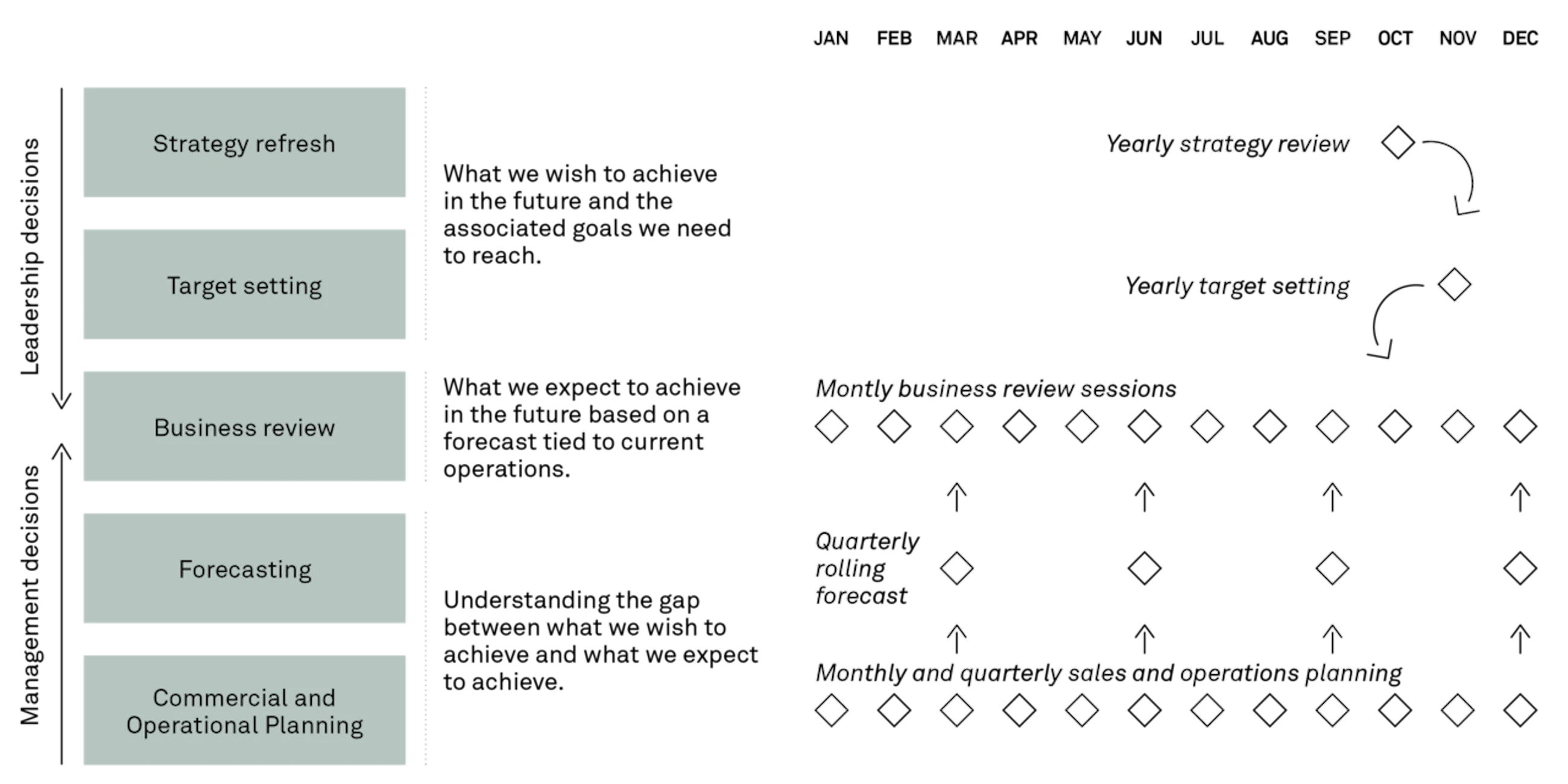
While the concept of integrated business planning is often described through its tools, data models, or meeting cadence, the real backbone of IBP is the flow of decisions through the organisation. In effective IBP setups, leadership intent flows down from the top of the organisation, while commercial and operational insights flow up from the business. The ‘spine’ is where these two worlds meet in a structured, repeatable business review process.
At the top of the spine sits leadership’s strategic direction: long-term ambitions, financial targets, commercial priorities, and the constraints or guardrails that define what the organisation is trying to achieve. These decisions must cascade clearly and unambiguously into the planning cycle. Without that clarity, functions default to historical baselines, personal interpretations, or local optimisation – exactly the behaviours IBP is meant to overcome.
At the bottom of the spine sit the operational realities: demand signals, supply constraints, capacity choices, pricing dynamics, resource needs, and risk assessments. These insights, forecasts, and scenario views must be channelled upward in a structured and timely way so leadership can see the consequences of its strategic ambitions reflected in real-world assumptions and operational trajectories.
IBP works when these two flows meet – systematically, rhythmically, and transparently – in a business review process designed to answer one core question: What is the gap between what we wish to achieve and what we currently expect to achieve? This gap-based dialogue is the engine of IBP. It forces clarity on assumptions, highlights mismatches between aspiration and execution, and creates a space where cross-functional decisions can be made based on one shared outlook rather than many competing ones.
But for this spine to hold, every function must participate in the same way and on the same cadence. Sales cannot forecast on one rhythm while Operations plans on another. Finance cannot analyse performance on a different set of assumptions than the commercial teams. The alignment of these rhythms – and the discipline to sustain them – is what turns IBP from a conceptual model into an operating model.
Organisations that succeed build this backbone deliberately. They design clear roles and decision rights. They define which decisions are made where along the spine. They create planning cycles that force strategic cascades to meet operational insight. And they require leaders to engage consistently – not episodically – with the integrated process.
Those who get IBP right do not underestimate this effort; they recognise that building the spine is a multiyear change in how the organisation thinks, works, and decides. It requires consistency, focus, and visible ownership from the top. And increasingly, those who succeed also pair this behavioural change with modern FP&A tools that enforce shared assumptions, strengthen planning discipline, and make the integrated process scalable across the enterprise.
Organisations that succeed with the topdown / bottomup alignment at the heart of integrated business planning tend to follow a clear and disciplined pattern. They do three things exceptionally well – each reinforcing the spine that connects strategy to execution.
1. Strategy and target setting that acts as a guiding star
The starting point is clarity. Leadership defines the strategic ambition, the financial guardrails, and the priorities that matter most for the enterprise. This is not a long list of aspirations. It is a sharp, directional set of objectives that tells the rest of the organisation three things: This is where we are going. This is what matters. And these are the constraints within which we operate.
These targets – commercial, operational, and financial – cascade down the spine. They anchor planning. They shape resource allocation. And they ensure that every function is forecasting against the same ambition, not their own interpretation of it.
Without this toplevel clarity, the rest of the IBP model wobbles. With it, the entire planning system has a stable point of orientation.
2. Rolling forecasts provide frequent, reliable outlook
Successful IBP organisations do not rely on episodic forecasting anchored to budgeting deadlines. They build a rolling, driver-based forecast that updates the enterprise outlook regularly and credibly.
This is where modern planning systems become essential. A system-enabled rolling forecast ensures that:
A rolling forecast becomes the planning ‘heartbeat’ – the mechanism that translates operational signals into a consolidated, financialised view of what the future currently looks like.
3. Meaningful touchpoints bridge strategy and operational reality
The final differentiator is discipline in how the organisation brings topdown ambition and bottomup insights together.
High-performing IBP organisations design intentional touchpoints – monthly or quarterly business reviews – where strategy and operational forecasts converge. These are not performance-reporting meetings. They are decision forums.
Their purpose is to answer one question:
What is the gap between what we want to achieve and what we currently expect to achieve – and what are we going to do about it?
When executed well, these touchpoints allow leadership to:
This is where IBP becomes a living operating model rather than a conceptual framework.
The case for integrated business planning is now clearer than ever. The benefits are compelling: one plan, one set of assumptions, and one shared understanding of the future. Organisations that succeed reduce planning friction, improve forecast accuracy, strengthen cross-functional alignment, and shift their energy from reconciling numbers to making better decisions based on them.
At the same time, the challenges should not be underestimated. Transitioning from fragmented, Excel-driven planning to an integrated model requires more than a new process. It demands a fundamental behavioural shift – one that cuts across Sales, Operations, Supply Chain, Finance, and the rest of the enterprise. The shift is difficult precisely because it requires new disciplines, shared assumptions, common rhythms, and, above all, a willingness to plan for the enterprise rather than for the individual function.
The organisations that make IBP work do so by following a set of proven practices. They create a clear strategy and target-setting process at the top to provide direction. They build a rolling, system-enabled forecast that gives the business a frequent, credible view of its expected trajectory. And they bring these two elements together through meaningful business reviews designed not for reporting the past, but for improving the future.
Yet even these best practices only work when leadership treats IBP as a strategic transformation rather than a technical exercise. Success depends on visible, sustained leadership commitment – from defining the ambition to reinforcing the behaviours required to make it real. Where leadership shows consistency and focus, IBP becomes a disciplined operating model. Where leadership hesitates, the organisation quickly slips back into siloed habits.
The moment for leadership action is now. Modern, AI-enabled planning systems have reached a level of maturity that makes integrated business planning both achievable and scalable. These tools dramatically reduce manual effort, enforce shared assumptions, and provide the analytical horsepower needed to support a truly forward-looking planning model. The barrier is no longer technology. It is leadership intent.
CFOs who embrace this shift will help their organisations move faster, decide better, and operate with greater coherence across the value chain. And in a market where speed, foresight, and resource allocation are decisive, those who act today will gain a meaningful competitive advantage over those who wait and set the standard for how modern enterprises plan, decide, and execute tomorrow.


