Article
Translating strategy to commercial action in Transport & Logistics

Published
2 March 2026
In the boardroom of an international Transport & Logistics (T&L) company, the strategy might be clear: win in selected geographies, double down on specific industry verticals, focus on large, multi-country customers, ideally in high-end modes where operational excellence is strongest.
It sounds decisive. It is backed by data. It is printed on high-quality gloss (read: fancy PowerPoint slides). Yet six months later, a sales representative in a regional branch is still spending 80% of their time chasing low-margin spot quotes for a local textile manufacturer.
In the world of T&L, this unfortunate outcome is not rare. And it does not necessarily have to do with poor execution or disconnected strategy as much as it does with a faulty translation. Why? Because the distance from the boardroom to the port, terminal, cross-docking facility, or warehouse floor is arguably longer in T&L than in any other industry. Between strategic intent and commercial action lies a complex, multi-dimensional matrix of modes, geographies, industry verticals, and customer segments. If that gap is not intentionally bridged, the matrix will not just absorb the strategy. It will slowly dilute it until, you guessed it, we are back to business as usual.
The matrix trap: why T&L strategy fails at the commercial frontline
T&L organisations are uniquely layered. A single shipment is not just a product – there are no SKUs in T&L. What is being sold is rather a co-produced service involving a mode (air, ocean, road, rail, warehouse), a geography (e.g., APAC origin with destination in MEA – and possibly even in transit), a vertical specialisation (pharma, automotive, retail, technology, defence, etc.), and a customer segment (e.g., global key account vs. local spot). On top of that, you even have a ton of value-added services integrated into the offering.
Because of this structure, cascading a strategy is not a linear process but rather a complex translation exercise across continents and departments, designed to make it resonate with every single employee along the journey. When a CCO announces a new strategic commercial direction, it passes through several ‘translation gates’:
The interpretation bias: A product head for ocean freight and a country MD in Germany will hear the same strategy but interpret it through their own P&L priorities.
- The communication funnel: By the time a global message reaches a local sales team, the ‘why’ is often lost, leaving only the ‘what’.
- The default mode: In a low-margin, high-pressure industry, middle managers and sales reps. default to what they know – the notorious ‘low-hanging fruit’ – rather than the ‘strategic fruit’.
Without a robust framework for implementation, the strategy becomes nothing but a fancy PowerPoint deck that sits untouched on the shared drive, and the organisation continues to execute yesterday’s priorities.
Introducing the Commercial Cascade Ladder
But to turn strategic intent into repeatable commercial behaviour, leaders need more than a PowerPoint deck; they need a sequential model that accounts for the multi-dimensional nature of the industry. At Implement Consulting Group, we have dubbed this the Commercial Cascade Ladder.
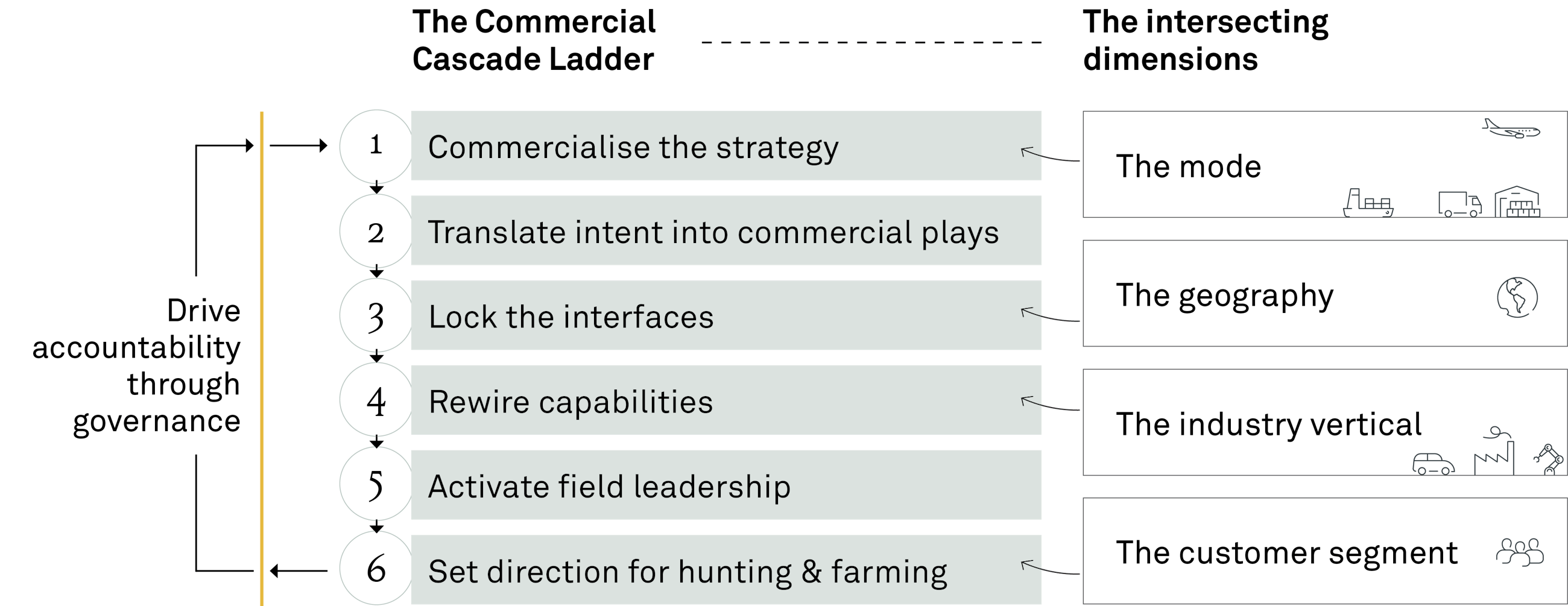
The ladder helps leaders to view strategy through four intersecting dimensions:
- The mode: Air, ocean, road, contract logistics
- The geography: Global, regional, and branch-level execution
- The industry vertical: Vertical-specific value propositions
- The customer segment: Global blue-chips vs. SME/local accounts
Translation is only successful when the strategy remains consistent across all four faces of the cube. To achieve this, we look at seven critical building blocks.
The seven building blocks of strategic execution
Time and time again, we see how companies struggle to embed strategy consistently across dimensions. The complexity of balancing offer, customer, industry, and geography often leads to fragmentation rather than focus.
Based on numerous transformation projects, we have distilled what truly differentiates successful strategic execution. The result is seven critical building blocks that ensure the strategy holds together across the entire Commercial Cascade Ladder – both in theory and in day-to-day practice.
The seven building blocks of strategic execution
Cross-ladder: drive accountability through governance
Finally, the cascade requires a feedback loop. This is not limited to quarterly business reviews or leadership meetings; it also demands revisiting the adoption of the strategy, layer by layer, ensuring that every level of the matrix is held accountable for the behavioural shifts required by the strategy, not just the lagging financial indicators. This is where P&L accountability comes alive, where strategy becomes action, and where a performance-driven culture is established.
The diagnostic: is your strategy actually reaching the commercial frontline?
To assess whether your organisation is truly aligned – or merely nodding in agreement – ask these five questions:
- The elevator test: Can a frontline sales rep. name your top three commercial/customer priorities without looking at a slide?
- The pricing test: Are your tender management and pricing teams adapting their discounting logic to favour strategic ‘must-win’ segments?
- The data test: Are your pipeline reviews tied to live CRM data that explicitly tracks open opportunities?
- The incentive test: Are bonuses and commissions behaviourally linked to strategic priorities rather than just total gross profit or revenue?
- The collateral test: Does your sales team have standardised, high-quality collateral for the specific verticals you have targeted?
If the answer to more than two of these is ‘No’, or at best questionable or unclear, then your strategy is likely stuck in the upper layers of the matrix and unable to translate effectively to execution-level performance.
From intent to commercial action
In the fragmented and consolidating T&L landscape, the winners will be the companies that can move with the greatest agility from the boardroom to the terminal. As such, it can be argued that the art of translating strategy into unified commercial behaviour is an investment in management discipline. It requires time, planning, and a relentless focus on the ‘commercial cascade’. By using a structured model like the Commercial Cascade Cube outlined above, T&L leaders can ensure that their strategic choices are not just a vision for the future but the reality of today’s sales call.
Want to know more?
Related0 4
Article
Read more

Patient activation
Why turning patient intent into action is pharma's next commercial opportunity.Article
Read more

Move as fast as your market
Your strategy may be too static for a changing world – four moves that will make it fit for the future and move as fast ...Article
Read more

AI in grocery retail
Grocery retailers can use AI to improve decisions, margins and customer relevance.Article
Read more