Article
Why automation and AI raise the demands on factory-floor leadership


Article
Read more
21 October 2026
In Toyota's early plants, every workstation had a cord. Pull it, and the line stopped. Any worker who spotted a defect did not just have the right but the obligation to stop production.
The mechanism itself cost almost nothing, just installing a simple cord and switch. What made it so valuable was what happened next: when someone pulled it, a signal appeared (Andon) and a leader would show up, not to assign blame, but to solve the problem, on the spot, at the line. The interruption was treated as a signal for improvement rather than an embarrassment.
In practice, the value of the system depends on that response. Remove the leader who walks towards the cord, and the cord has no value. Workers quickly find out whether pulling it gets a problem solved or earns them a reputation for slowing things down. In the latter case, the cord will just hang there, collecting spiderwebs. The line may look calmer, but only because the problems are no longer being raised.
Most automation business cases carry a quiet assumption about leadership: fewer people on the line means fewer people to lead, which in turn means the leadership task shrinks. A reasonable assumption, albeit often a wrong one. In our experience, automation requires more leadership, better leadership, and, ultimately, a whole other type of leadership.
Whereas a manual line hides its problems in the noise of daily firefighting, an automated line surfaces them – faster, more precisely, and in more places at once. While technology can help identify the issue, every surfaced problem is a demand on someone with the authority and the nerve to act.
This is the part of a concept called Jidoka that most of the industry has moved past too quickly. Jidoka is one of the two pillars of the Toyota Production System, alongside just-in-time, and it means, roughly, automation with a human touch. Sakichi Toyoda's loom, patented in 1924, was the first machine to embody it: it stopped itself automatically the moment a thread broke, rather than continuing to weave a flawed piece of cloth.
But the stop was only half the invention. The other half was the human who came to take a look, diagnose, and improve, and the very leadership system that made showing up and solving the problem the norm rather than the exception.
Companies that treat automation as a technical rollout leave that half of the invention to nobody. The companies that actually scale automation and AI take the human side just as seriously as the mechanical side.
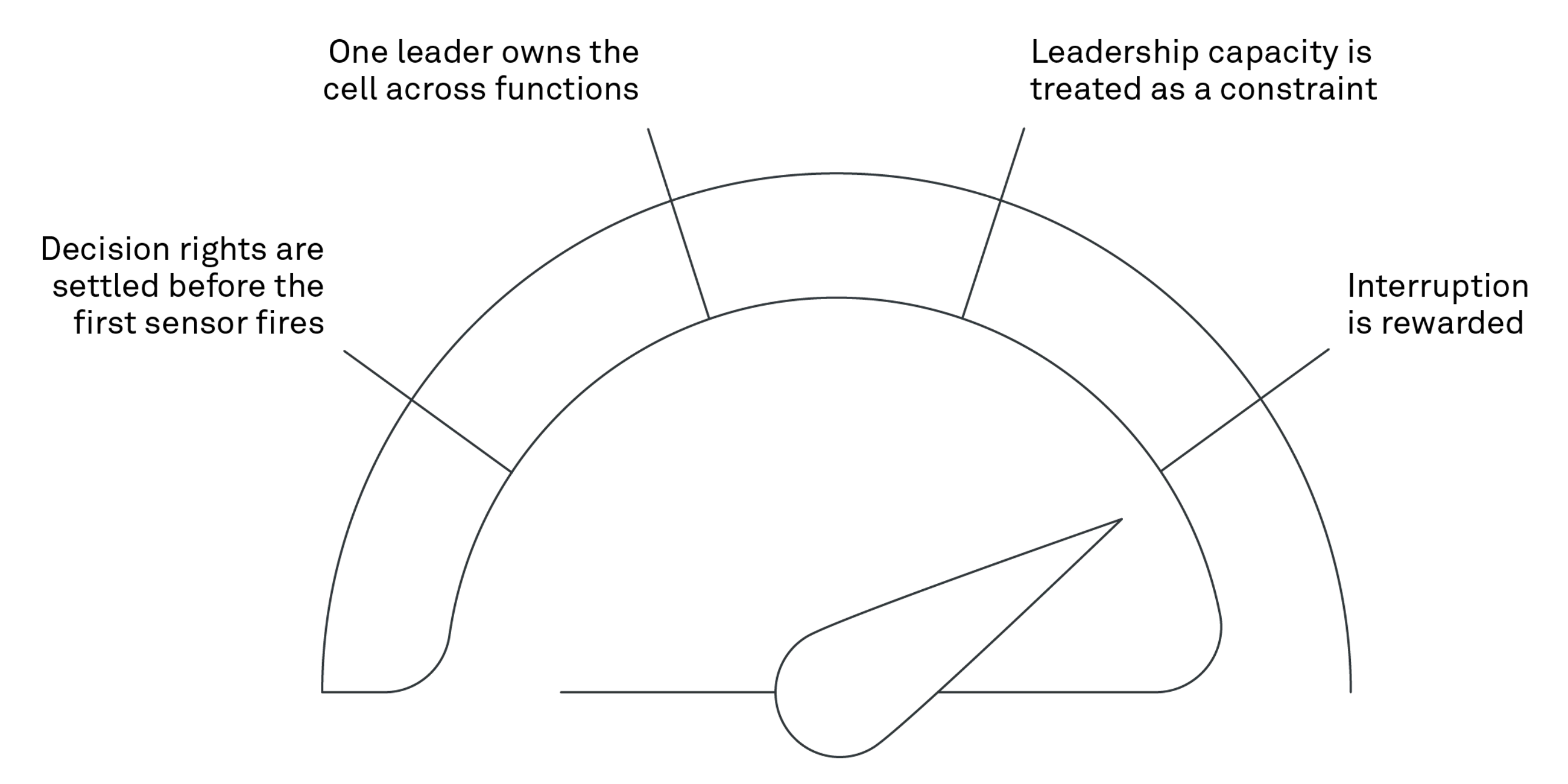
In our experience, four organisational conditions move the needle:
We have seen this pattern directly. In engagements with manufacturers, earlier initiatives had already fixed most of what could be fixed at the machine level. The technology was never the constraint. Decision rights blurred between shifts, no line owned the standard across its length, and site leadership was too consumed by daily operations to hold any change in place. The organisation was what needed fixing.
Think of AI as the cord, one that gets pulled continuously rather than just once a shift. A vision system inspecting every unit, a predictive model watching every bearing, an algorithm re-planning the schedule in real time – each generates the same kind of signal the Andon cord once did, just far more of them and far more often. And where the classic cord asked a leader one question – will you please come and take a look? – AI asks harder ones:
This is why the leadership question sharpens rather than fades as technology matures. A manual line forgave weak leadership design because humans papered over the gaps. An AI-enabled line executes the design it is given, including those gaps. The more decisions the machines and AI make, the more deliberate leaders must be about the decisions they keep.
Across programmes that survive past the pilot and actually scale, five leadership behaviours recur:
None of these requires understanding robotics. But each one of them requires something rarer: a leader willing to be interrupted, in public, by a problem, and to treat that moment as an obligation to improve.
Do it properly, and be brave. It is the kind of thing parents could tell their children before a match or an exam – and it also happens to summarise a century of production leadership rather well.
Do it properly is the discipline: the standards, the decision rights, the ownership, the freed-up capacity.
Be brave is the rest: walking towards the cord in front of everyone, letting the line stop on your watch, owning the stop instead of chasing down who caused it, overruling an expensive algorithm when your judgement says so, and being visibly wrong sometimes in a culture you have made safe enough to allow it.
The cord was never the hard part. Neither, it turns out, is the AI. A century after Sakichi Toyoda's loom first stopped itself, the scarce resource is unchanged: the leader who runs towards the problem.
The machines have learned to pull the cord. The question for your factory is the same as it was in 1924. Who comes when it is pulled?
The first article in the series explores why advanced automation only scales in factories where Lean already lives.
Read the article