Article
A systemic approach to creating leadership principles that are anchored in organisational context and drive strategy execution

Article
Read more
14 September 2026
Today’s leaders operate in an environment that has become complex in ways that go beyond being busy or stretched. Competing stakeholder demands, shifting market conditions, cultural transitions, and geopolitical changes are all happening simultaneously. What makes this particularly demanding is that leaders must navigate external turbulence and internal expectations at the same time. While markets shift and competitive pressures intensify on the outside, organisations are also raising the bar on what they expect from their leaders on the inside. Leaders are caught in the middle, expected to respond to both demands with equal clarity and conviction. This convergence of pressures is not something that individual capability alone can resolve. Instead, it calls for a shared language across the leadership chain and a collective framework for how to lead.
In this complex landscape, the need for supporting leadership principles has never been more pressing. When designed well, these principles give leaders at every level a common direction to navigate by, helping them make decisions when priorities compete, translate strategy into everyday behaviour, and move in a unified direction without waiting to be told what to do.
Yet most organisations still approach the design of leadership principles in ways that fall short of this ambition. The focus tends to land on the individual leader: what traits to develop, what behaviours to model, what kind of leader to become. And while that matters, it misses something fundamental about how leadership actually works.
Leadership does not emerge from individuals in isolation. It takes shape inside a system, through the context leaders operate in, the conversations they have, and the way strategy is translated into everyday decisions across the organisation. This is why designing leadership principles cannot start and end with the individual leader. It requires a more systemic approach, one that builds a shared language and ensures that principles are not just defined and then rolled out but mindfully brought to life while they are being shaped.
Working with global organisations on leadership principle design, we have seen the same patterns emerge. When we look at why most leadership principles do not work, the answer is rarely the principles themselves. The wording might be thoughtful, the behavioural descriptions on point, and the launch well-orchestrated. Yet a year after launch, the principles only live in an onboarding deck, and day-to-day leadership carries on largely unchanged.
The gap between defining leadership principles and shifting how leadership actually shows up tends to come down to five common traps. In our experience, they show up when organisations are not intentional about how to run the project but too focused on what the project should produce at the end.
The first trap is when leadership principles become an isolated HR initiative, shaped by the latest trends in the people and culture space rather than the strategic reality the organisation is facing. Concepts like resilience, psychological safety, and emotional intelligence matter. But when they become the primary language of leadership principles, the principles quickly lose their grip on the business context leaders are actually navigating. Leaders struggle to see how any of it connects to the decisions they are making, the tensions they are managing, or the strategy they are expected to deliver.
The second trap is when organisations deliberately involve many leaders at the beginning of the process, but involvement narrows as the work progresses. What starts as a broad conversation ends as an exercise where a small group of senior executives write principles that reflect their own perspective without any check on their own biases. We are aware that no set of principles can reflect every voice in an organisation. But when the gap between stated involvement and actual influence becomes too big, the launch stops feeling like a shared direction and starts feeling like a message handed down from above.
The third trap is launching principles without a compelling narrative and a clear philosophical standpoint on leadership. Words on post-it notes and PowerPoint slides do not shift how leaders think. What creates movement is a narrative that connects the principles to a bigger idea – one that challenges existing thinking and invites leaders into something worth belonging to. Without it, even well-crafted principles become hollow, and principles that are not felt do not shape a shared leadership language.
The fourth trap is when organisations become so focused on ensuring the new principles align with every existing framework that the principles end up saying nothing distinct. When they must align with values, cultural beliefs, operating guidelines, and competency models all at once, leaders cannot tell them apart from what already exists. In the effort to make everything connect, organisations also miss a valuable opportunity to clean house; to let go of old frameworks that no longer serve their purpose. New principles carry a new mindset and a new direction, and that freshness can generate real energy if it is not buried beneath the weight of everything that came before.
The fifth trap is aspiration without diagnosis. Principles built entirely around a future ideal of leadership, without any serious attempt to understand what is blocking that ideal today, tend to feel disconnected from lived reality. Every organisation carries collective patterns and cultural dynamics that make certain leadership behaviours harder to practise. Those patterns do not disappear because new principles have been launched. When the design process creates space for leaders to surface what is actually standing in the way, the conversation becomes honest, and the principles that emerge carry far more weight because they were shaped by where the leaders stand today.
Taken together, these five traps point to a common underlying issue: leadership principles design projects are too often treated as a content exercise where the goal is to create a framework that can be explained and rolled out. Ideally, they should be treated as a process that starts a movement from day one, where a new leadership language begins to take form as the work unfolds.
Another common denominator across the five traps is that they all treat the organisation as a static system rather than a living one. The design process focuses on what leadership should look like but rarely pauses long enough to ask what kind of organisation is doing the leading. That question turns out to matter enormously.
For decades, the dominant mental model of organisations has been a mechanical one: strategy is set at the top, execution follows beneath, and leadership is a lever to be pulled in the right direction. This model leads to a predictable mistake when designing leadership principles. When we see an organisation as a static system, we design principles the way we would design a new operating procedure. We define three headline principles, describe the behaviours beneath each, roll them out, and train for compliance. The principles enter from above and are expected to cascade downward.
We suggest the alternative is to understand the organisation as a living system that is constantly adapting, generating meaning through the interactions of its people, and shaped by external forces at every level simultaneously. In this kind of system, leadership is not a role, but an activity distributed across the whole. Leadership happens in the conversations leaders have, in the choices they make under pressure, in the way they interpret the strategy on a Tuesday morning when they must balance cost reductions and a specific customer need.
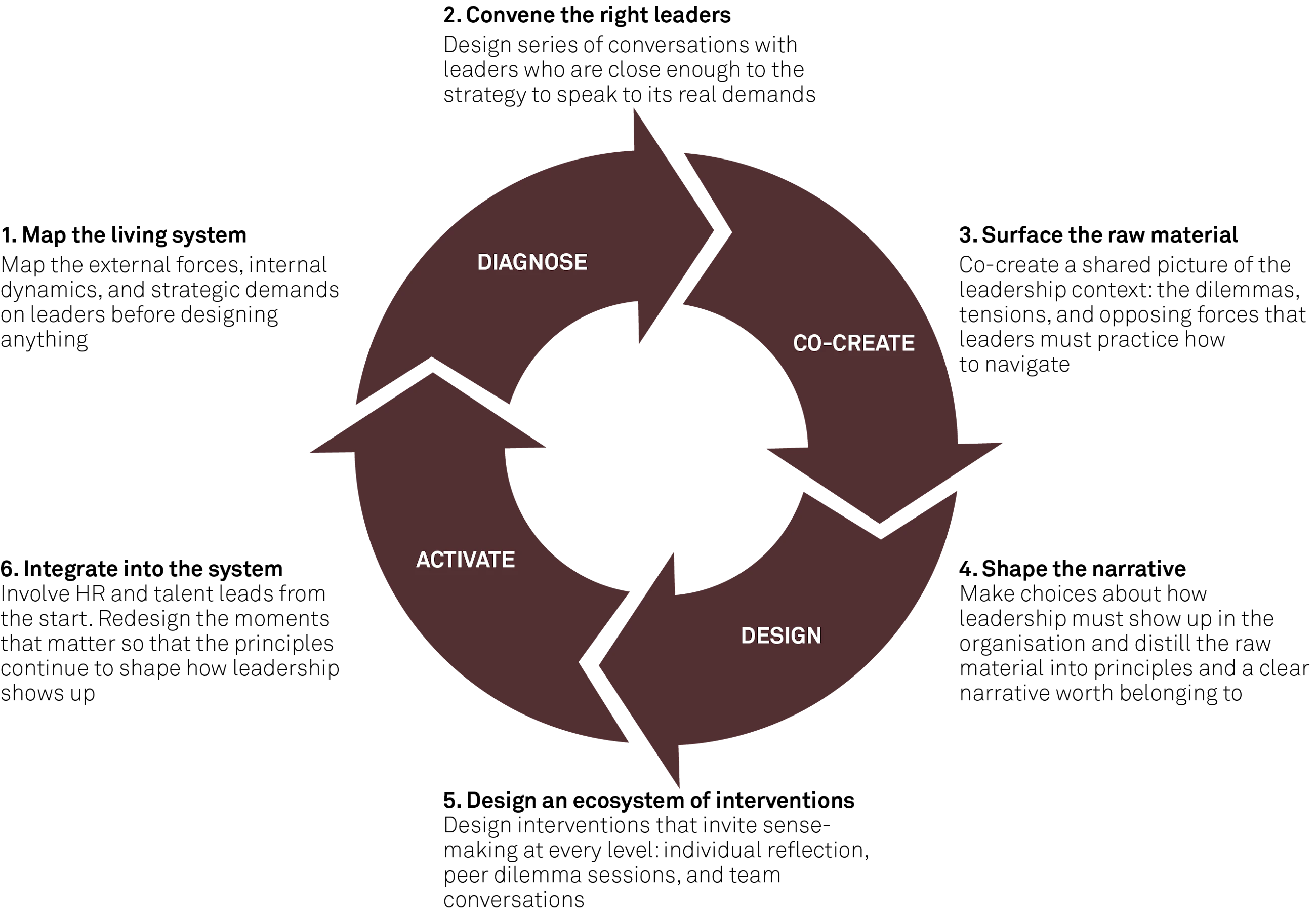
This shift has direct consequences for how leadership principles should be designed. Living systems respond to engagement, disruption, and invitations to grow. They resist instruction. Principles imposed from the outside, however carefully crafted, tend to be rejected by the organisation's existing culture and ways of working, just as a body triggers an immune response to an incoming bacterium. This is why we always begin with a thorough examination of the organisation as it actually is today by raising the following questions:
When taking a systemic approach to leadership, we map this reality across multiple levels: from the macrosystem forces shaping the competitive landscape, to the internal organisational dynamics, to the team-level conversations that either reinforce or prevent the culture the organisation is trying to build. The goal is to understand the living system well enough that the principles we design will actually fit inside it and have a real chance of taking root. What this approach produces is fundamentally different from a top-down cascade model. Rather than handing principles down to an organisation, we focus on surfacing principles that emerge from an honest conversation rooted in the organisation's current reality.
Context is not background; it is what the principles must respond to. Across our work with global organisations, we encounter vastly different contexts. Some are in the middle of post-merger integration, trying to shape a unified leadership culture from two distinct legacies. Others are accelerating growth in new markets, where the speed of execution demands a kind of leadership the organisation has not yet fully developed. Some are navigating cultural change that requires leaders to let go of behaviours that once made them successful. Others are facing a performance turnaround, where the pressure to deliver short-term results sits in direct tension with the need to build long-term capability. And some are using leadership itself as an employer brand differentiator, making the promise of great leadership central to how they attract and retain talent.
These are all different contexts, but what they share is that each strategic direction presents its own series of dilemmas, tensions, and opposing forces that leaders must practise how to navigate. Strategy rarely asks leaders to choose one clear path. More often, it asks them to hold several competing priorities at once: to move fast and bring people along, to standardise and stay locally relevant, to protect what works and be willing to disrupt it. These tensions cannot be treated as problems with a single right answer. They are the terrain of leadership in a complex environment, and they must be explored and navigated collectively. This is precisely where well-designed leadership principles can help – not as answers, but as a shared guide for how to orient when the path is not clear.
This is why getting selected leaders involved early in the design process matters so much. They hold the most honest and complete picture of what leadership looks like today, and they are closest to the gap between where leadership currently stands and what the organisation needs to execute its strategy. In practice, this means designing the early phases as a structured series of conversations with leaders who are brave enough to name the tensions others may hesitate to articulate, and close enough to the strategy to speak to its real demands. The goal is not to reach consensus on what the principles should say, but to start building a shared language and a collective picture of the strategic paradoxes the principles will need to address.
Critical questions to ask include:
These questions, when asked in the right setting and with the right people in the room, generate a quality of insight and conversations that no desktop analysis or HR survey can fully replicate. They reveal the lived complexity of leadership in that specific organisation, at that specific moment in its strategic journey. And it is from that honesty that leadership principles with real weight can emerge.
When the raw material for leadership principles is drawn from these conversations, something important shifts. The principles that emerge are not generic expressions of what good leadership looks like according to the latest HR trends, but specific responses to the real tensions and context shaping leadership in that organisation. As such, they carry the fingerprints of the people who helped design them and because of that, they carry a different kind of authority when shared with the broader leadership community – the authority of something built from the inside, shaped by people who truly understand the terrain.
Designing a strong set of leadership principles is only half the work. The other half is deciding how to bring them into the organisation in a way that shifts how leaders think, act, and execute the strategy day by day. When the design process has been carried out through co-creation, the starting point for activation looks quite different. The conversation has already begun, and chances are, the principles will feel recognisable to those who helped shape them. A movement of sorts is already underway. The work now is to create a ripple effect that reaches the entire leadership ecosystem through a well-thought-out intervention design.
Author and change coach Deborah Rowland offers a perspective worth pausing on here. In her writing on leading systemic change, she argues that what matters most in organisational transformation is not the content of the change but the quality of the process through which it moves through the system. The how simply carries more weight than the what. Change, she suggests, is not something that needs to be introduced from the outside; it is an inherent property of organisational life, already present and already moving. Our task as process facilitators is to tap into the nature of that adaptive, living system.
This is also why we deliberately choose to speak of an activation process rather than a rollout process. The distinction is not only semantic. It reflects a fundamentally different set of assumptions about how organisations change and how a shared leadership language takes root. Moving from a controlled, top-down approach to one that is emergent and explorative requires a different mindset and a different kind of skillset.
At the core of this choice is the belief that an organisation does not adopt a new leadership language because it has been instructed to. A shared way of leading takes form when the conditions are right for people to make genuine sense of it, connect it to their own experience, and gradually see it reflected in the conversations and decisions around them.
This is why, before any intervention is designed, a set of deliberate philosophical choices must be made about how leadership is understood in the organisation.
Questions worth raising before designing the interventions include:
Sitting with these questions early shapes everything that follows – the tone of the narrative, the design of the interventions, the rhythm of the process. When the activation process itself embodies a clear and considered response to these questions, the principles move from mere words on a slide to something worth believing in. A clear and compelling narrative is therefore not a communication task to be completed after the principles are finalised. It is an outcome of the design process itself – one that helps leaders make sense of why these principles matter now, what they are asking leaders to do differently, and how they connect to the strategic moment the organisation is navigating.
Beyond the narrative, the nature of the interventions carries meaning in its own right. There is a significant difference between an executive town hall that presents new principles to the organisation and a dilemma session where leaders work together through real strategic tensions using those principles as their guide. Both might be described as activation activities, but only the latter invites leaders into the kind of active sense-making that actually shifts how they think. Interventions that draw on active involvement, such as dilemma discussions, simulations, board games, gamified quests, coaching circles, and structured conversations across levels, do something a presentation cannot. They create collective experiences. And when principles are brought to life through real experience rather than handed over as instruction or information, that is when a new leadership language begins to take hold.
The ambition is to design an ecosystem of interventions that works across multiple levels simultaneously. At the level of the individual leader, this means creating conditions for personal reflection about what the principles ask of them specifically. At the level of leader-to-leader relationships, it means designing conversations where the principles are tested against real dilemmas and used to navigate strategic tensions. At the level of teams, it means equipping leaders with the tools and language to translate the principles into the everyday conversations they are already having. And at the enterprise level, it means building a narrative and rhythm that keeps the principles visible, alive, and connected to the strategy as it evolves.
What unites these levels is conversation – probably the smallest and most powerful tool available for shifting a leadership culture. The dialogues leaders have with themselves and with others shape identity, beliefs, and behaviour over time. Every meeting, every coaching exchange, every moment at the margins of a strategy review is an opportunity to reinforce or undermine the leadership language the organisation is trying to build. Designing those touchpoints intentionally and supporting leaders with the skills and structures to hold real conversations within them is what separates an activation process that creates movement from one that merely creates awareness.
In the conventional approach to leadership principles, leadership development comes last. First, the principles are defined. Then they are launched. Then development begins, usually in the form of a leadership programme designed to help leaders live up to the behavioural expectations attached to each principle. This sequencing fits the mechanical thinking about how change happens, and it is logical – at least on paper. In practice, however, it tends to produce exactly the kind of disconnect described throughout this article. By the time development begins, the principles have already been positioned as a finished product to be adopted rather than a living language to be practised.
When the design process is carried out as we have argued here, something fundamentally different becomes possible. Co-creation does not only produce better principles; it also starts the leadership development process well before the launch. The leaders who participated in surfacing the strategic paradoxes, testing hypotheses, and shaping the language of the principles have already begun developing a new mindset and shared vocabulary that sets a new tone for how to lead. They have practised navigating real tensions. They have built a shared language with their peers. They have deepened their understanding of what the strategy actually demands of them. Leadership development, in this sense, is not a stand-alone deliverable initiated at the end of the activation process but an ongoing activity that began the very moment the project was set in motion.
This reflects a broader shift in how we understand the purpose of leadership development. The dominant model for much of the last two decades has positioned development primarily as a competency-building exercise, focused on the individual leader and aimed at helping each person live up to behavioural expectations.
At Implement, we approach leadership development as business development, where the goal is not self-improvement for its own sake but to help organisations build a greater collective leadership capacity to adapt, navigate complexity, and execute on the strategy as it evolves. This moves the design of leadership development programmes away from the assumption that leadership capacity resides in individuals and can be grown through training alone, towards the understanding that it emerges from the quality of relationships, conversations, and collective decisions across the leadership system. When leadership grows in this sense, the organisation's ability to deliver on its strategy grows alongside it.
This shift has direct consequences for how leadership development is designed in relation to leadership principle projects. Rather than translating each principle into a behavioural description that leaders are trained to perform, the more powerful approach is to introduce a set of leadership practices directly linked to the strategic paradoxes the principles are meant to address. These leadership practices equip leaders to act with intention in moments of complexity, translate the strategy into the daily decisions and conversations they are already having, and support the people around them to do the same. Practised over time, they become the foundation for ongoing leadership development across the organisation, not as a programme with a fixed start and end date, but as a continuous capacity-building process embedded in the actual work of leading.
Leadership is learned through doing, through testing new approaches in real situations, receiving feedback, and reflecting on what actually changed as a result. The most effective development happens in the flow of work, where leaders are advancing key priorities and practising new ways of leading at the same time. That is when the principles stop being a framework to be explained and start being a set of choices that leaders reach for naturally, because they have experienced firsthand what it means to lead by them in the moments when doing so made a notable difference.
At some point, the energy generated through co-creation, the interventions initiated in the activation process, and the ongoing experimentation with new leadership practices begin to settle. When they do, the principles must be able to sustain themselves in the structures, processes, and rhythms that govern how the organisation operates. This is anchoring work, and it is where many well-intentioned leadership initiatives fall short because too little effort was put into thinking through how the surrounding system could continue to support the principles once the initial momentum has passed.
Anchoring must already be considered in the design phase, by involving the people who will ultimately own the integration. HR business partners, talent leads, and those responsible for performance and development processes need to be brought into the conversation as the new leadership practices and language are taking form. When they are involved early, the principles have a real chance of becoming part of how the organisation hires, develops, reviews, and recognises its leaders – in a way that mirrors the living system thinking that has shaped the design and activation process from the start.
Seeing the organisation as a living system changes how we approach the HR lifecycle and the natural entry points for integration it offers. Recruitment processes can be redesigned so that the principles shape not only what the organisation looks for in new leaders but also how it looks, and the way new people are invited in. Onboarding can be structured so that new leaders encounter the principles not as a document to read but as a set of dilemmas and conversations that help them understand what leadership means in this particular organisation while deepening their understanding of the strategic context. Performance and development conversations can shift from individual competency assessments towards a more collective and contextual dialogue about how leaders are navigating the strategic tensions the principles were designed to address.
Talent management frameworks can use the principles as a lens for identifying where in the organisational landscape leadership is strong and where the system needs to grow or adapt. Thinkers like Giles Hutchins, writing on regenerative leadership and living systems, use the metaphor of acupuncture to describe this kind of targeted intervention: small, precise actions applied at the right pressure points in the system, capable of releasing energy and shifting patterns that more forceful approaches could never reach.
In the anchoring phase, it also becomes relevant to revisit the over-alignment trap described earlier. When organisations attempt to integrate new leadership principles into an already crowded landscape of values frameworks, competency models, performance criteria, and cultural programmes, the principles tend to lose their grip. They become one more layer in a system that already has too many layers, and leaders stop being able to tell them apart from everything else that already exists. The anchoring phase is therefore also an opportunity to clean house and to ask which existing frameworks and processes are still serving their purpose and which ones have outlived their usefulness.
Perhaps the most significant shift in the anchoring phase is in how leadership itself is measured and recognised. Much of the conventional infrastructure still frames leadership performance as an individual matter, assessed through personal objectives, 360-degree feedback, and individual development plans. While these tools have their value, they reinforce the idea that leadership is primarily something that happens inside a person rather than between people and across the system. Complementing these with collective measures of leadership – looking at how leadership communities are functioning, how well teams are navigating complexity together, and how consistently the principles are shaping decisions at every level – offers a fundamentally different and more complete picture of where the organisation actually stands.
When the principles are anchored in this way, they stop being something that was introduced at a particular moment in the organisation's history and start becoming part of how the organisation understands itself. They become the lens through which leaders make sense of their work, the language through which they challenge and support each other, and the foundation on which the organisation's collective capacity to lead continues to grow over time.
Leadership principles projects are rarely positioned as transformation initiatives. They tend to be seen as something more contained: an HR deliverable, a cultural refresh, a necessary update to the leadership framework. And when they are treated that way, they deliver accordingly.
But when a leadership principles project is designed the way we have described here – starting from a living system understanding of the organisation, grounded in co-creation with the people who know the strategic terrain, activated through an ecosystem of interventions that invites leaders into collective sense-making and the experimentation of new leadership practices, and anchored into the structures and rhythms that govern everyday leadership – it becomes something else entirely.
It becomes a catalyst for building the collective capacity to lead, and through that, a lever for executing the strategy. The reason is straightforward. The design process itself, when done well, is already a leadership intervention. From the first conversations about the tensions leaders are navigating, to the workshops where strategic paradoxes are surfaced and named, to the moments where leaders discover that others across the organisation are wrestling with exactly the same dilemmas. All of this is development. All of this is cultural movement. The principles that emerge at the end of this process carry a different kind of energy than principles that were written in a room and then communicated outward – because they carry the collective effort that went into making them.
We have seen this play out in organisations navigating post-merger integration, where leaders from two distinct cultural legacies found a first opportunity to build something shared in the co-creation process. We have seen it in growth businesses, where the act of naming the leadership paradoxes at the heart of the strategy gave leaders a language for conversations they had been having in silos for years. We have seen it in performance turnarounds, where surfacing the collective barriers to better leadership created the honest starting point that previous initiatives had missed.
In each of these cases, the principles themselves were important. But what made the difference was the process that produced them. The movement that had already begun before the principles were formally launched. The shared language that had started to form in the rooms where the hard conversations were being had.
This is what it means to treat a leadership principles project as a process rather than a content exercise. The principles become the visible output of something much larger: a systemic effort to understand the organisation as it is, to surface what leadership must become to execute the strategy.
For HR leaders and leadership experts looking to make leadership a true lever for strategy execution, this approach is one answer. Leadership principles designed this way do not describe the leadership culture you want to build – they help you become it as you shape them.
Smith, W. K., and M. W. Lewis. Both/And Thinking. Boston: Harvard Business Review Press, 2022.
Allen, K. E., S. P. Stelzner, and R. M. Wielkiewicz. "The Ecology of Leadership." Journal of Leadership Studies 6, no. 1–2 (1999): 62–82.
Kegan, R., and L. Laskow Lahey. Immunity to Change. Boston: Harvard Business Review Press, 2009.
Rowland, D. Still Moving: How to Lead Mindful Change. Chichester: Wiley, 2017.
Hutchins, G. Future Fit: How to Stay Relevant and Live with Purpose in the Future of Work. CreateSpace, 2016.
Storm, L., and G. Hutchins. Regenerative Leadership. Wordsworth Publishing, 2019.
Weick, K. E., K. M. Sutcliffe, and D. Obstfeld. "Organizing and the Process of Sensemaking." Organization Science 16, no. 4 (2005): 409–421.
Martin, R. L. Playing to Win: How Strategy Really Works. Boston: Harvard Business Review Press, 2014.
Bruner, J. Acts of Meaning. Cambridge, MA: Harvard University Press, 1990.