Article
From Socrates to Silicon Valley: placing human sense-making at the centre of AI-driven organisations

Article
Read more
28 May 2026
According to Socrates, the Greek gods invented writing to cure the forgetfulness of humans – only to discover that it had the opposite effect. When humans became able to document things in writing, our memories deteriorated. What we gained in technological sophistication, we paid for with our cognitive abilities.
It does not take a Socrates to connect the dots between the invention of writing and the introduction of AI into workplaces across the world. Soon, this new technology will have relieved us of numerous tasks. Going to the internet to do your own research will soon be as antiquated as going to the well for water. Even sitting down to type this article word by word on a keyboard seems somehow like an anachronism. Why not just feed a couple of sentences to Copilot and have it come up with a draft?
Well, because that would not feel right.
And this is exactly the intersection organisations will need to navigate. If we want to successfully merge the processing power of AI with the sense-making power of humans, we need to make people feel good about the new division of labour.
And ‘feeling good’ means establishing a sense of agency and belonging. As humans, we need to feel that we are in control of what is happening, and we need to be able to digest the output that AIs produce. In short, leaders need to make sure their workplaces continue to feel emotionally meaningful, as well as rationally comprehensible for the humans who inhabit them.
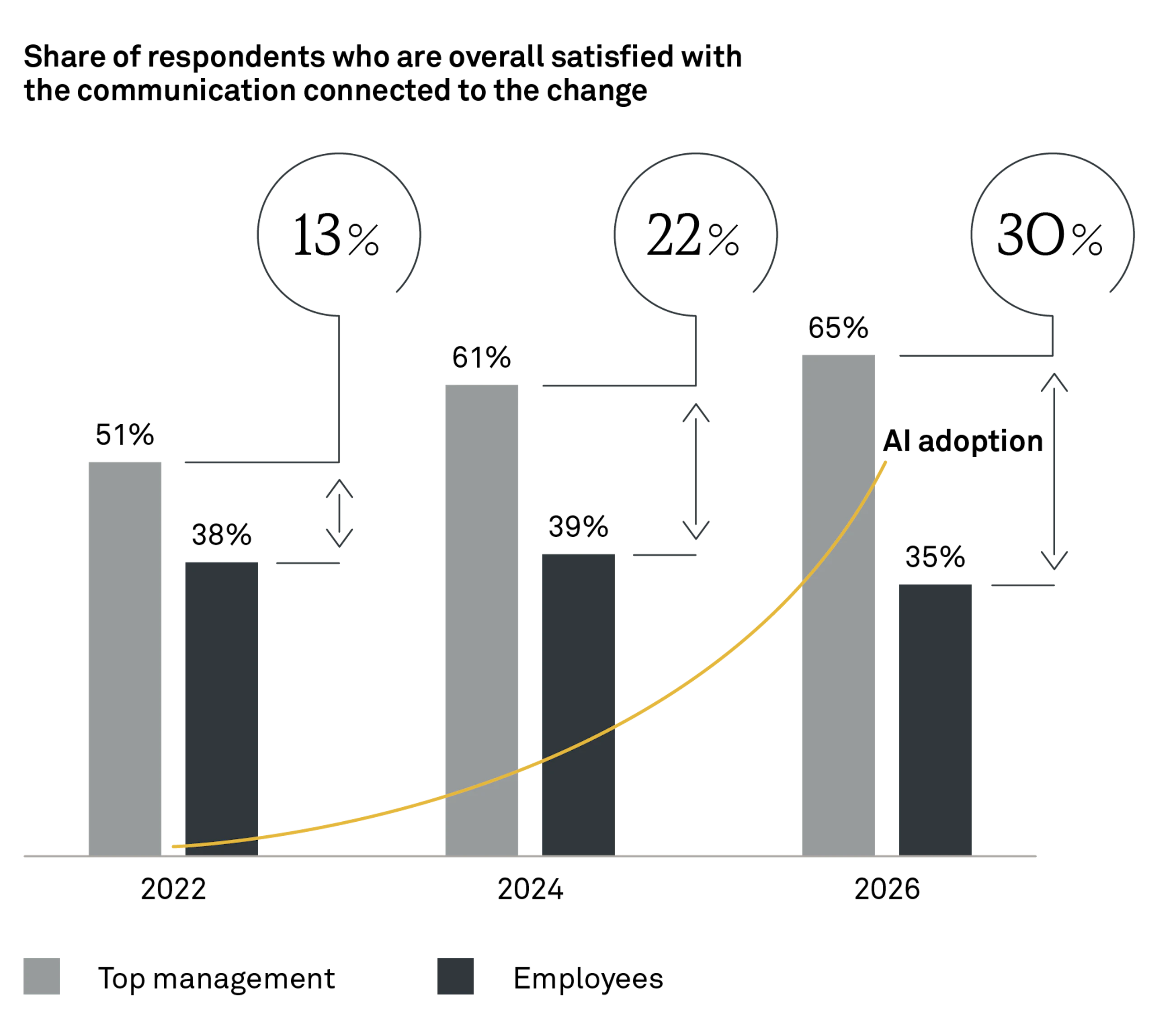
Unfortunately, it does not seem like organisations are succeeding with this fundamental sense-making. Numbers from our most recent Implement Change Communication X-Ray that surveys the state of change communication with over 800 respondents shows that the perception gap between top management and employees is increasing.
While a majority of top managers are satisfied with the communication around changes taking place in the organisation, only 35 percent of employees agree. And this gap has been growing significantly for the past four years.
This fallout coincides with a rapidly increasing number of AI adoption projects, as illustrated in the yellow curve in the figure below. The X-ray survey does not investigate whether there is a causal relationship, but it is hard to ignore the timing.
The current discourse is preoccupied with how best to realise the productivity gains of AI. Finance functions, supply chains, and shopfloors are scrambling to harness the new technology. From a human vantage point, this reconfiguration of workflows is a painful process because it is associated with a sense of upheaval and loss. And as always, there is a host of doomsayers throwing fuel on the fire with predictions of rising tech oligarchies and the demise of the job market.
Yet none of us today begrudge the Greek gods their invention of writing, nor the engineers who put in plumbing for running water in our households. The purpose of this article is not to fret about AI. As with any other new technology, it is how humans use it that will determine its impact – for good or bad.
So, while we should not fear AI, we should of course respect it. Because with the impact on day-to-day workflows and the disappearance of routine tasks comes a risk of diminished social connection and purpose with the people whom we rely on to guide the technology and move our organisations forward.
A study by the American Psychological Association found that participants who relied heavily on AI felt that the system “did most of the thinking,” and they reported lower confidence in their own reasoning and reduced sense of ownership over ideas. Importantly, participants who actively challenged or modified AI outputs did not show these effects.
A similar pattern emerges in a recent analysis from the Thompson Reuters Institute, which links heavy AI reliance in organisations with a shift to a more transactional workplace culture and weakened perceived meaning of work.
AI can elevate the productivity of organisations, but it cannot provide a meaningful work environment. And even the productivity part is doubtful if there is not a strategy in place to preserve human-to-human interactions and reinforce a sense of agency and critical thinking.
So, just as we are building new technological ecosystems, we should be working to hardwire humanity into our organisational ecosystems. The more we accelerate processes and decision-making, the more important it becomes to instil the feeling of a human hand on the steering wheel.
Winning organisations will be the ones that are able to connect emotionally with their employees and maintain an organic, value-driven culture on top of the technological advancements. Learning how to write does not mean we should stop talking. Just ask Socrates.
Here are five things you can do to prepare your organisation for an AI-supported work environment:
AI Tools in Society: Impacts on Cognitive Offloading and the Future of Critical Thinking, American Psychological Association
Neural and Cognitive Impacts of AI: The Influence of Task Subjectivity on Human-LLM Collaboration, Thompson Reuters Institute
Implement Change Communication X-Ray 2026, Re-writing change