Article
… and how to get there

Article
Read more
28 August 2026
“What do you wish you could say about your organisation that you cannot say today?” That’s the question we have been asking CXOs at large organisations for the past year. More than 100 conversations later, a clear pattern has emerged.
They want:
They want organisations that can execute faster, moving from decision to results more swiftly. However, they are struggling to build the organisational muscles to adapt to change.
They long for cultures with greater ownership, accountability, and empowerment – especially of middle management and the frontline. Cultures where every single person has agency and uses it actively.
They desperately want to get ahead on AI and identify the acupuncture points that can accelerate both speed and agency at scale – leveraging it as a competitive advantage.
Together, these findings add up to a wish for a more vital organisation – an organisation that is fully alive, from the C-suite to the frontline. An organisation that is alert and responsive to its surroundings. Continuously sensing, seizing opportunities, and evolving to stay competitive. An organisation where everyone has both the agency and the expectation to act – and does so fast.
In our work with clients, we have found the concept of strategic agility highly useful for building more organisational vitality.
Strategic sensitivity is the ability to perceive and interpret complex situations as they unfold – sensing and making sense in real time. It means paying intense attention to the outside world rather than relying on plans and forecasts. It requires real-time information from many sources, alertness to the unexpected, and the discipline to believe what we see, not see what we believe.
AI dramatically expands how much intelligence organisations can absorb, but interpretation matters as much as information. To embrace this dimension fully, organisations need to be good at both sensing in the frontline and sensemaking on the back of inputs. Sensemaking requires wide-lens thinking, open dialogue, and a strategy process that reaches beyond the CEO and inner circle.
Key accelerators:
Case example: A client organisation wanted to accelerate strategy execution by sharing strategic information more broadly. Rather than sending around a PowerPoint deck, they developed an AI-powered chat interface, which allowed people to not only search for, but also interact with the strategy. This effectively enabled strategy-aligned decision-making across the organisation.
Resource fluidity is the capacity to rapidly reconfigure business systems and redeploy assets (e.g., funding, talent, knowledge). In many organisations, moving substantial resources across functions or regions is cumbersome and slow due to budget processes, conflicting agendas, and KPIs. Lean cultures are optimised for full utilisation and leave no room for reserves, but unallocated resources are the simplest way to preserve strategic agility. Slack is not a sign of inefficiency; it is a strategic buffer.
Hence, resource allocation should be an ongoing process. Yet, in most companies, allocation patterns repeat year after year, reflecting internal power dynamics more than strategic priorities. Beyond budgeting flexibility, resources must actually move. Common management disciplines, shared operating systems, and consistent people practices reduce the friction that keeps resources stuck.
Key accelerators:
Case example: A client organisation wanted to create more freedom and flexibility for exploration into new areas. They introduced low-cost slack resources into the system by training cadres of specialised AI agents – ready to be mobilised as opportunity (and curiosity) strikes. Thoughtfulness is, of course, always required when evaluating when to leverage agentic AI versus humans, weighing both the nature of the work and corporate responsibility.
Leadership unity is the top team's ability to make bold, fast decisions together without being paralysed by politics or consensus-seeking. Some decisions are painful – e.g., exiting a core business or reallocating resources away from what made the company successful. They require a team that can disagree openly, then commit fully. Unity depends on psychological safety and interdependency – conditions where leaders contribute freely without constantly proving themselves. Shared purpose can act as an important tiebreaker in hard decisions and a compass beyond the C-suite.
Key accelerators:
Case example: One senior leadership team in a large global energy company was preparing for a major transformation and invested deliberately in optimising their team dynamics. They gathered for two leadership offsites of 2-3 days time and focused on building trust and psychological safety through assessment insights, shared experiences and real courageous conversations. Their collaboration strengthened and became the foundation for leading the transformation as a unified team.
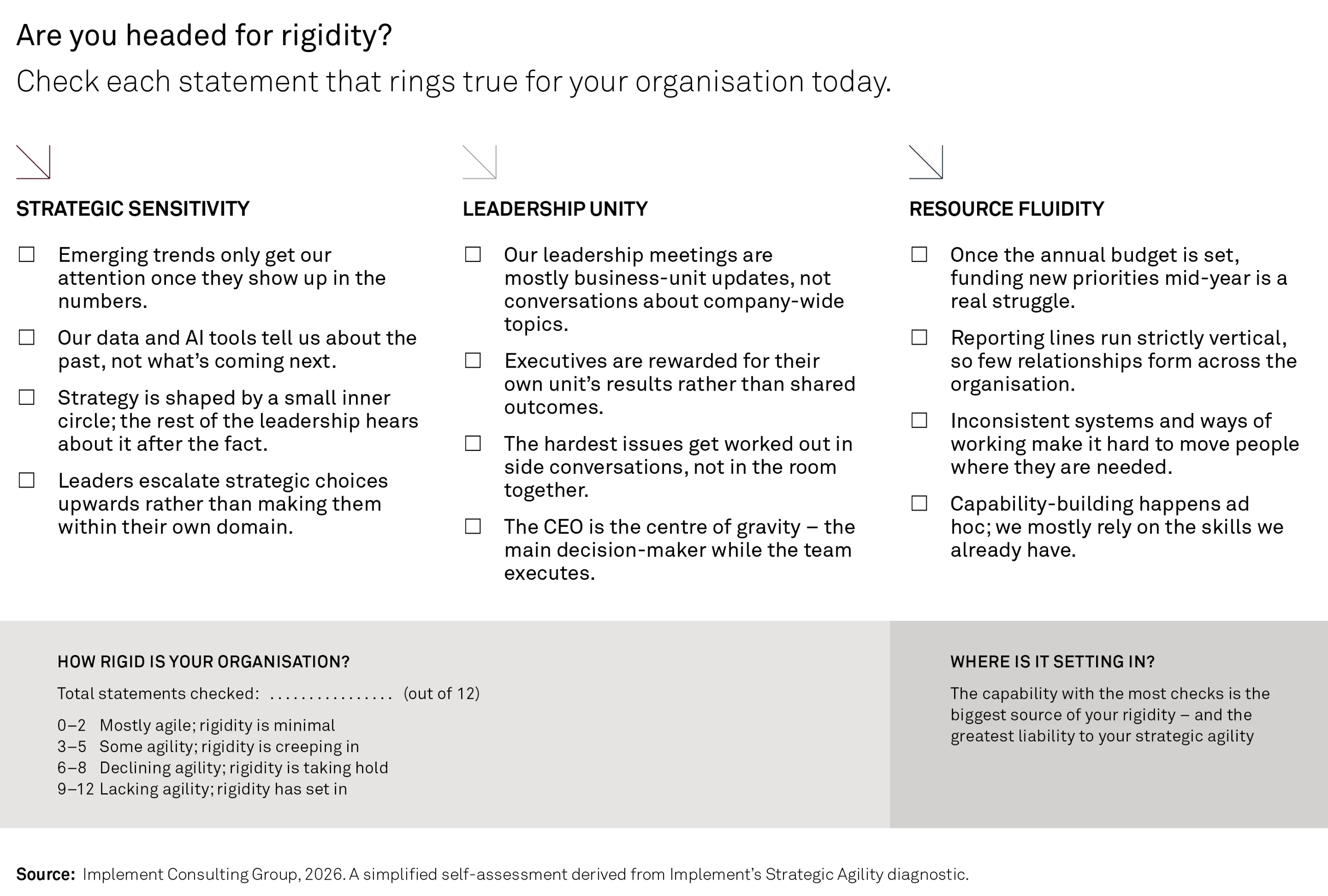
Can an organisation be too strategically agile? In theory, yes – stability and change must coexist. In practice, the bigger risk cuts the other way: most organisations default to stability, staying the course too long and ending up slow, rigid, and solving yesterday's problems. We see this consistently across CXO conversations and client work. The self-assessment below can help you to recognise the signs of too much rigidity – and too little agility – in your organisation.
Our challenge for you: In your next leadership conversation, dare to have a courageous conversation where you take an honest look at:
Doz, Y. L., & Kosonen, M. (2008). Fast Strategy: How strategic agility will help you stay ahead of the game. Pearson Education.