Article
How a Finance Transformation Office can balance control and change

Article
Read more
16 December 2025
In today's dynamic business environment, companies face the perennial challenge of balancing stable operations with pursuing transformative change. As highlighted in our previous exploration of rightsizing during uncertain times, this balancing act is crucial for organisational resilience and growth. But how can businesses achieve this equilibrium effectively, especially within Finance functions under intense pressure to adapt rapidly? Think like an airport: you need a control tower. The answer lies in structured execution led by a dedicated Finance Transformation Office (FTO) – the central hub that provides line of sight, coordinates traffic, and keeps transformation on course while operations continue to run safely.
Finance functions today are at a crossroads, required not only to manage day-to-day operations efficiently but also to drive strategic transformation. The reactive, scorekeeping role is evolving into a proactive, strategic partner demanding end-to-end excellence and innovative solutions. Yet, the journey from operational efficiency to transformational leadership is fraught with challenges:
Economic geographer Bent Flyvbjerg’s research on megaproject statistics provides a stark reminder of the challenges inherent to large-scale projects. Out of 16,000 megaprojects globally, only 0.5% meet time, budget, and benefit expectations. This so-called ‘Iron Law of Megaprojects’ (over budget, over time, under benefits) helps to illustrate the critical need to design programmes differently, emphasising strategic planning, robust governance, and cross-functional stakeholder engagement.2
Large, business‑critical finance transformations surface the same transformation challenges seen in many enterprise programmes. Common pitfalls include rushing the start, setting goals that do not fit the organisation’s needs, and underinvesting in programme organisation and stakeholder management across Finance, IT, and the business. Three disciplines consistently make the difference:
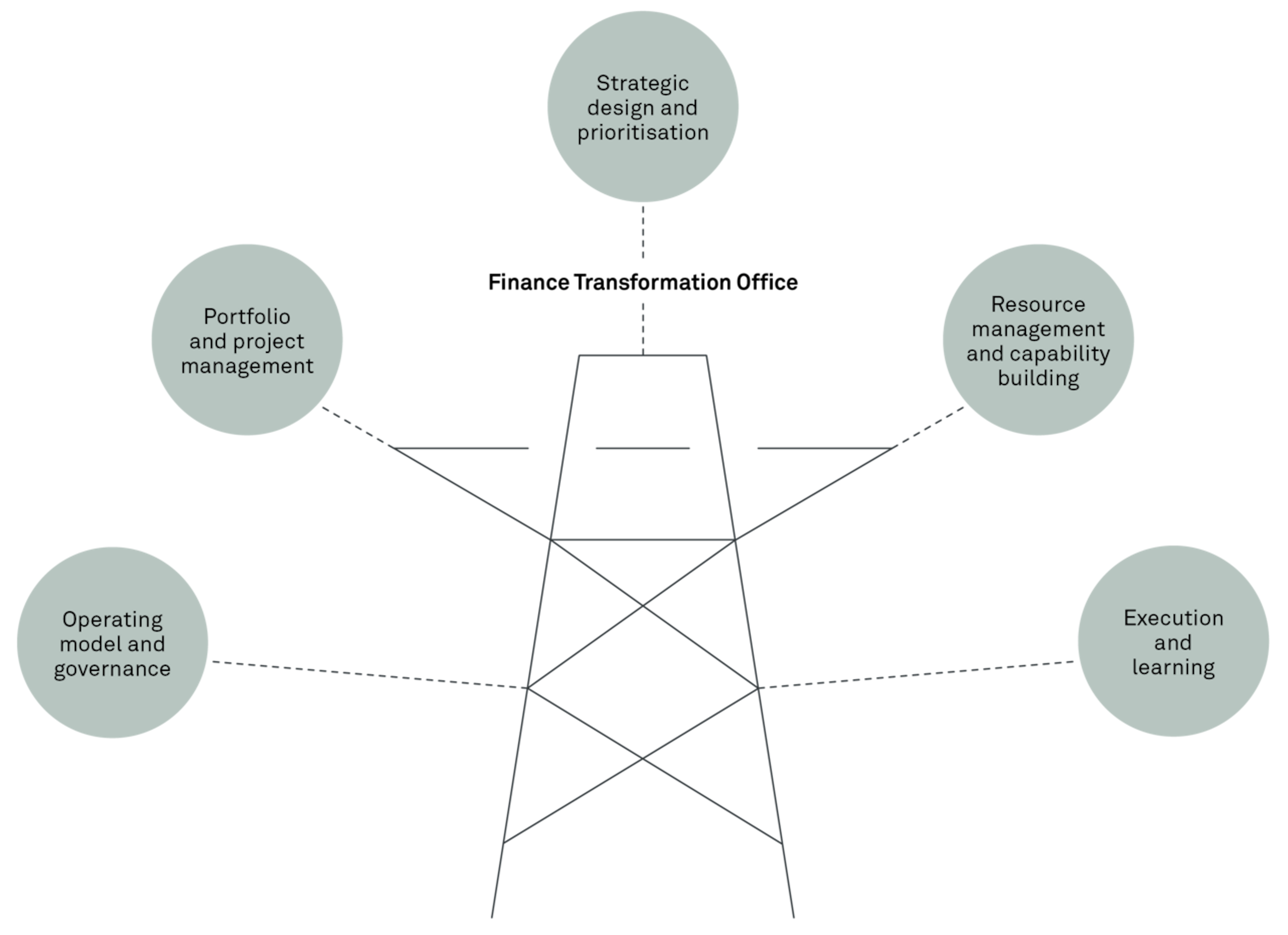
Confronted with these challenges, a well-structured Finance Transformation Office (FTO) can serve as the linchpin for effective transformation. Like a control tower, the FTO acts as the centralised hub that directs complex transformation programmes through robust project management and disciplined governance.
Here’s how the FTO keeps transformation on course:
Setting up an FTO is akin to building and commissioning a control tower – you need to establish the purpose, design the operating model, define the flight rules, manage a safe transition, and train the crew. Done well, the FTO enhances the finance strategy's success and strengthens the finance operating model over time:
As we navigate the complexities of Finance transformation, the lessons from ERP implementations and rightsizing during uncertain times, coupled with Flyvbjerg’s compelling statistics, remind us that structured execution, cultural engagement, and strategic vision are essential. With a Finance Transformation Office as the control tower, organisations can not only navigate turbulence but chart a steady course toward enduring growth.
1Argenti, P. A., Berman, J., Calsbeek, R., & Whitehouse, A. (2021, September 14). The secret behind successful corporate transformations. MAHA Global. https://maha.global/blogs/the-secret-behind-successful-corporate-transformations-by-paul-a-argenti-jenifer-berman-ryan-calsbeek-and-andrew-whitehouse/ Maha Global
2Flyvbjerg, Bent: ‘What You Should Know About Megaprojects and Why: An Overview’ (2014)


