Article
Why OKRs are the missing link in modern performance management


Article
Read more
7 October 2026
It is the Monday after quarter close. Every metric on the CFO’s dashboard reads green. Revenue is on plan. Costs are on plan. Margins are on plan. However, nobody in the room can answer whether the business is changing fast enough to still be relevant in three years?
That is the strange comfort of a good KPI system. It tells you the car is running well. But it says little about whether you are heading in the right direction.
The finance function has taken on more territory than at any point in its history. More than 70% of CFOs now hold responsibilities that extend well beyond core finance.1 Ninety-five percent say their role has broadened in recent years.2 Geopolitical volatility, capital discipline, AI adoption, ESG reporting, and a widening talent gap have all landed on the same desk, often in the same quarter.
The measurement system has not expanded with the job. Most CFOs can still tell you precisely how the business performed last month. Far fewer can tell you, with the same confidence, whether it is changing fast enough to matter. That gap is not a reporting problem, but a design problem.
KPIs were built to run the business, not to change it.
Every performance conversation holds two conversations at once. One is operational. Are we efficient, consistent, and in control? The other is strategic. Are we moving towards what the business needs to become? A traditional dashboard answers the first question well. It was never built to answer the second.
Take cost and growth. Recent Gartner research found that 56% of CFOs rank cost optimisation among their top five priorities for 2026. In the same survey, capital allocation for growth is the single most-cited number one priority. Cost discipline and growth ambition are the brake and the accelerator, pressed at the same time, and a KPI dashboard has no way to flag that the two pedals are in conflict. It simply reports both readings as green.
That is precisely the blind spot a traditional KPI system cannot see. KPIs are excellent at telling you whether you are executing well, but much weaker at telling you whether ‘executing well’ is still the right ambition.
Key performance indicators remain the backbone of operational management. They create transparency, track efficiency and reliability, and establish accountability where it is needed most, the day-to-day running of the business. Their limitation is structural, not a matter of poor execution. KPIs are lagging by design. Once tied to compensation, they drift toward conservative target-setting rather than ambition.3
And the rear-view mirror is not always clean. Data quality failures, not technology gaps, are now the most cited operational bottleneck in CFO surveys. Cherry Bekaert's (2025) Middle Market CFO Survey found that 49% of respondents said poor data quality prevents them from making critical financial decisions.4
When the underlying data cannot be trusted, a KPI dashboard stops being a rear-view mirror and becomes a cracked one. You are no longer just looking backward. You cannot even see clearly what is behind you.
Objectives and key results take the opposite orientation. Objectives define ambitious, directional goals. Key results define the measurable outcomes that mark progress towards them. The first formal academic comparison of the two frameworks characterised OKRs as a “target decomposition tool” that is compatible with KPIs rather than a replacement for them.5 Where KPIs protect current performance, OKRs are built to disrupt it. They force prioritisation and translate strategic intent into the small number of things a team should focus on right now.
No serious study recommends choosing one framework over the other. KPIs are the dashboard. OKRs are the steering wheel.
| Dimension | KPI | OKR |
| Purpose | Monitor ongoing performance | Drive ambitious change |
| Time horizon | Continuous, long-term | Quarterly, short cycles |
| Orientation | Lagging: past performance | Leading: future outcomes |
| Ambition level | Achievable targets (100% = success) | Stretch goals (~70% = success |
| Link to pay | Often tied to compensation | Typically decoupled from pay |
Sources: Hao and Yu-Ling 2018, Rompho 2024, Wulff et al. 2025, Cunha et al. 2025, and Huang et al. 2025.
The more theoretically grounded framing describes this as organisational ambidexterity. KPIs manage exploitation, i.e., doing current things well; OKRs manage exploration, i.e., doing new things.6 Keeping the engine running and choosing which road to take are both necessary, and they call for different instruments.
The same logic plays out wherever finance must deliver change under pressure. A fraud detection objective to cut fraud losses by 30% is an OKR, but it still needs a KPI, like detection accuracy, to hold it accountable every quarter. A programme to compress the monthly close from eight days to five using AI-assisted reconciliation is an OKR too, and it only means something if a cycle-time KPI keeps tracking it once the target has been hit.
The two systems only work if they stay structurally distinct. Poorly managed integration creates ‘OKR overload’ and metric confusion.7 When OKRs are linked to compensation, they start to behave like KPIs and lose their motivational stretch.8 The moment an OKR shows up in a bonus calculation, it has quietly become a KPI.
Moving from principle to practice calls for an architecture that connects strategic OKRs to operational KPIs. Three things separate the organisations where this sticks from the ones where it becomes one more slide in the deck.
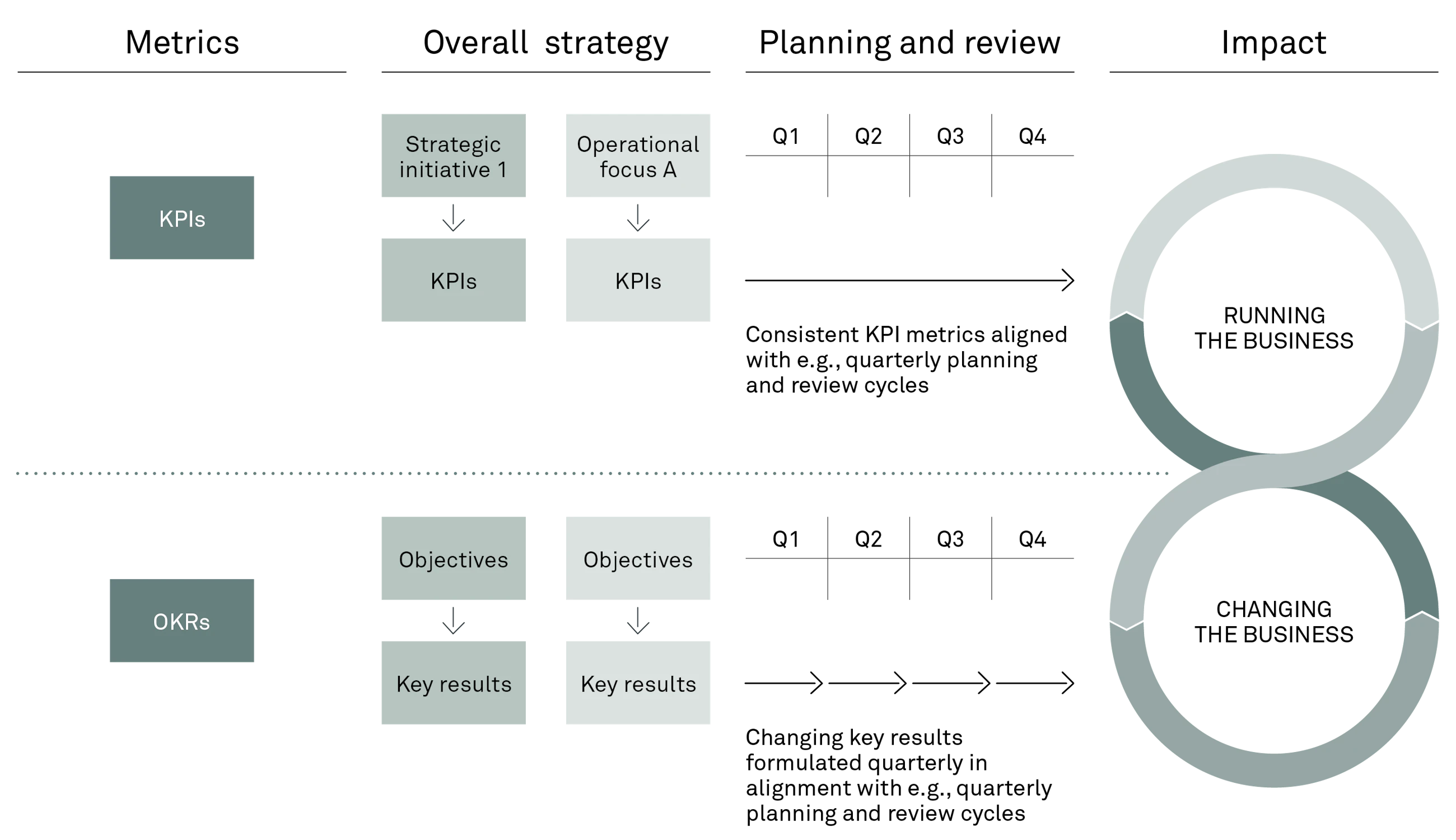
Connecting both frameworks to planning and review cycles lets each do what it does best. KPI metrics, tracked consistently over longer periods, reinforce operational efficiency. OKRs, formulated as short-term targets, typically quarterly, drive transformation initiatives. A shared strategic architecture is emerging to house both, one that gives KPIs a set of strategic perspectives to measure ongoing progress against while OKRs drive quarterly transformation across them. In one instance, applying this kind of integrated approach led to a reported 22.9% improvement in services delivered, a rare case where the theory translated into a measured result.9
A qualitative study across 22 organisations found that OKRs give middle managers a structured way to translate abstract strategy into team-level objectives people can act on. The study identified six mechanisms at work: goal orientation, reflection, feedback, empowerment, transparency, and communication.10 This is where most performance management systems quietly fail. Not at the top, where strategy is set. And not at the bottom, where the work happens. But in the middle, where one has to become the other.
Across successful implementations, six things consistently make the difference:
Together, these six disciplines create a continuous cycle where strategic ambition becomes a small set of executable objectives, reviewed frequently and refined as the organisation learns. OKRs do not replace existing performance management processes; they add a transformation layer on top of the KPI foundation already in place.
The finance function’s remit is not shrinking back to its old boundaries. Geopolitical exposure, AI ROI, ESG reporting, and talent development have all become permanent line items on the CFO’s agenda. Each one is, at its core, a question a traditional KPI dashboard alone cannot answer. Not “how are we doing?”, but “are we changing fast enough?”.
A traditional dashboard tells you how fast the business is moving and how much fuel is left in the tank. It has never once told a driver which way to turn. CFOs who pair the dashboard with a steering wheel, and who trust each instrument to do the job the other cannot, will be the ones who decide where their organisation ends up rather than just reporting where it has been.