Article
A systemic lens for leading transformations in a BANI world


Article
Read more
26 February 2026
Scenario: Six months into a major transformation, the executive team was confident. The roadmap was clear, milestones were being met, and governance was tight. Progress reports were all green. Yet on the frontline, adoption was uneven, customers felt little difference, the workforce was disengaged, and momentum was fading. Leaders sensed something was off but could not quite name it. The plan was sound; the problem lay elsewhere.
Most large-scale transformations fail in exactly this way. Research consistently shows that 70% of major programmes do not deliver their expected return on investment.1 Further, nearly all CEO’s (94%) identify pace of change in their external environment including shifts in customer behaviour, technology and competitive dynamics as a core leadership challenge that outstrips their organisation’s ability to respond.2 The common explanation is weak execution, insufficient change management, or resistance from employees or leaders. In practice, the deeper issue is more subtle: leaders apply linear logic to non-linear systems. Change is treated as a side activity that supports execution rather than as the mechanism through which strategy becomes real.
In practice, many transformations look successful on paper but leave customers largely untouched. New processes are implemented, structures are adjusted, and dashboards improved, yet from the outside, little feels different. When customers do not experience clearer value, simpler journeys, or better service, it is worth asking whether meaningful change has even occurred. Without customer-felt difference, transformation risks becoming an exercise in internal optimisation rather than strategic renewal.
In environments marked by volatility, uncertainty, and interdependence, this distinction matters. Increasingly, organisations operate in brittle, anxious, non-linear, and incomprehensible – BANI – conditions,3 where systems that look sturdy prove fragile under stress, overload erodes a felt sense of control, small inputs trigger disproportionate effects, and events resist coherent explanation. In this context, plans alone are not enough. What differentiates transformations that deliver from those that stall is not better roadmaps, but a different way of seeing change. Leaders must shift from managing change as a side activity to leading change as a systemic, ongoing capacity embedded in how the organisation thinks, decides, and acts.
When doing large-scale transformations, applying the concept of BANI reminds us that systems that appear robust can be fragile, that information overload breeds anxiety, that small moves can have disproportionate effects, and that complete understanding is neither attainable nor necessary. Recognising the BANI context strengthens the case for a new way of understanding and leading change – one that demands continuous sense-making, adaptive design, and leadership presence to lead complex transformations that turn strategy into outcomes customers can feel.
This article proposes a framework for systemic change – a holistic approach that integrates change management into every facet of transformation efforts as a leadership practice. The approach not only mitigates transformation risk but also accelerates impact, ensuring that transformations deliver their promised value.
Effective transformation depends less on individual tools than on the assumptions and patterns that guide how leaders interpret what is happening and decide what to do next.
For organisations to successfully navigate large-scale transformations, they must adopt a thinking mode that views change as an inherent part of their strategic fabric. Moving away from linear and disjointed models, the approach presented here encourages leaders to blend strategic thinking with real-time responsiveness when pushing change(s) forward. The core leadership task is to assess and understand the context of the organisation, the strategic vision, and the transformation at hand – and then shape and adapt decisions to move the transformation forward.
The thinking mode for change proposed in this article rests on a clear ontological and epistemological stance: organisations are living systems, and change is how strategy becomes real in those systems. What we choose to observe and value – customer-felt outcomes, collective contribution, conversational meaning, and system interdependencies – determines how we design and lead transformation. From a systems perspective, this requires moving from first-order observations (focusing on events and outcomes) to second-order observations: examining how the organisation observes, interprets, and defines what counts as success, resistance, progress, etc.4
The articulated approach to leading change rests on a small set of shared assumptions and recurring lenses that determine how leaders must see, interpret, design, and enact change.
Four propositions anchor a systemic lens on change. Each of them translates directly into leadership choices when navigating adaptive challenges and large-scale transformations. Together, they define how leaders must observe change – what it is, where it resides – guiding executives to make informed and timely decisions that drive complex change.
Four foundational propositions for seeing change
Effective transformation begins with how leaders interpret what is happening around them. Long before tools and roadmaps come into play, change is shaped by a small set of underlying assumptions about organisations, people, and strategy. The four propositions that follow make these assumptions explicit and translate them into practical ways of seeing that guide diagnosis, decision-making, and action.
Change is strategy execution
In contemporary organisations, change cannot be relegated to a peripheral ‘soft’ track; it is the operative mechanism through which strategy becomes observable performance. Rather than changing for the sake of change, the organisation adapts to preserve health and viability under shifting conditions, translating strategic intent into behaviours and outcomes that customers and stakeholders can feel. Designing from outcomes backward – starting with customer-felt value and tracing the causal chain to capabilities, processes, and decisions – anchors the transformation in measurable impact and keeps attention on the external validity of internal effort. Under this view, change is not preparatory to execution; change is execution.
Change is collective, not individual
The unit of analysis for meaningful change is the coordinated contribution to the organisation’s core task, not isolated motivation or discrete adoption events. Engagement emerges when people can situate their role within a shared purpose and progress narrative, experiencing themselves as part of a larger movement toward impact rather than as beneficiaries of personal gain. Practically, this requires aligning goals and capacity horizontally across teams and functions so that the organisation moves early and continuously in a coherent direction, thereby avoiding the fragmentation and latency characteristic of siloed initiatives.
Conversation is the smallest unit of change
Organisations are enacted through interaction; it is in conversation that meaning is constructed, commitments are formed, and norms are renegotiated. Change unfolds as a social and relational process in which people co-create understanding of why change is necessary, how it will be pursued, and what it asks of them, while tensions are surfaced and trust is built. When conversations shift toward a shared purpose, clarified expectations, and reciprocal accountability, practices begin to shift; and as practices shift, results follow. In this sense, conversational quality is not ancillary but causal in the trajectory of transformation.
Change lives in a systemic whole
No part of the organisation alters in isolation; outcomes are shaped by interdependencies and ripple effects across structures, relationships, behaviours, and culture as surrounding systems move. Small shifts rarely remain small: they propagate through incentives, routines, and informal networks, sometimes amplifying intended gains and at other times producing emergent constraints. Effective design therefore keeps the whole system in view, expecting emergence, reading weak and strong signals, and adjusting as context evolves. By treating change as a property of the system rather than as a project within it, leaders improve the coherence and durability of realised impact.
Together, these four propositions shape how leaders see the system. They are, in turn, operationalised through six recurring patterns that guide attention in complex change.
Across large-scale transformations, six lenses consistently distinguish momentum from drift. They provide a practical way of seeing and leading change in complex environments, translating the philosophical stance into guidance on where to place attention, how to interpret signals, and how to act under uncertainty.
Taken together, the proposed foundational propositions and systemic lenses reposition change from a linear side activity to a lived capacity of organisational systems – endemic, systemic, socially constructed, and led through experiencing, navigating, and sensing. The implication is practical and immediate: effective leaders do not merely plan; they continuously interpret and adjust, making consequential choices in context so that transformation efforts anchor successfully where it counts.
However, this alternative approach to change unfolds differently depending on the nature of the change at hand.
Transformations falter as often on misdiagnosis as on execution. A central distinction in leading change is between technical problems – issues resolvable through known expertise and established procedures – and adaptive challenges – situations that demand shifts in mindset, values, roles, and relationships. Although both can present with similar surface symptoms (delays, rework, resistance), they differ fundamentally in what authorises progress and how the organisation must learn.
Technical problems yield to established knowledge. They can be specified clearly, assigned to competent experts, and solved through the application of specific, existing skills and tools: engineering, programming, or scientific expertise. The authority in technical work is epistemic: correctness is determined by whether the solution conforms to accepted standards and produces predictable results. Organisationally, technical responses optimise existing structures and processes; they refine, stabilise, and scale within the current way of working, with meaning and norms largely intact. For example, an organisation keeps running into software issues that reduce efficiency. These issues can be solved by an expert who knows how to work with the system and has dealt with similar problems before.
Adaptive challenges, by contrast, are not questions of technique but of meaning and capacity. They manifest when the prevailing way of seeing, valuing, and relating is incompatible with the emerging context; progress requires learning that changes the system itself – mindset, ways of thinking, values, behaviours, and relationships. Authority in adaptive work is social: it arises from the collective reauthoring of purpose, roles, and norms through conversation and practice. Adaptive responses do not merely add tools; they cultivate new ways of working, redistribute decision rights, and embed different values in action so that behaviour and culture coevolve with context. For example, an organisation undertakes significant organisational change to better support business goals by redesigning the hierarchy, defining new roles, and establishing new communication channels across departments. The challenge is not only to implement new structures but to authorise and live different lenses of collaboration and decision-making.
The costly tendency is to treat adaptive challenges as if they were technical problems. As leadership expert and author Ronald Heifetz observed way back in the 1990s, the most common leadership failure stems from trying to apply technical solutions to adaptive challenges.6 That statement rings true to this day.
Hence, the core risk is misdiagnosis. Leaders may treat adaptive challenges as technical problems, or technical problems as adaptive challenges. When adaptive work is handled like a technical fix, procedures are prioritised over social authorisation, success is judged by internal activity rather than customer-felt outcomes, and the result is superficial compliance without behavioural integration. Uptake fades when conditions change, resistance is misread as noncompliance, and benefits fail to appear at the frontline. When technical issues are handled as adaptive, dialogue expands unnecessarily and scarce time is consumed, where focused expertise could have solved the problem quickly.
Misdiagnosis rarely stems from a lack of data but is a consequence of how the situation is being observed. From a second-order perspective, the leadership task is not only to diagnose the challenge but also to reflect on the observational frame through which the challenge is defined – technical or adaptive – and the blind spots that frame creates.
Diagnosing the nature of the change is therefore a continuous leadership practice. It asks, in context, who must change what for impact to be realised and by what authority that change will be authorised – expert validation or social re-authorisation. It invites leaders to read weak and strong signals through the six lenses: to notice when issues are bounded and procedural, and when they are systemic, endemic, and socially constructed, calling for experiencing, navigation, and sensing rather than linear control.
This discernment prepares the ground for an integrative, attention-based way of leading change. Adaptive challenges call for parallel attention to outcomes, meaning, and system conditions, while technical challenges concentrate attention with limited anchoring in context.
Taken together, the thinking mode for change suggested above recasts change as a lived capacity of organisational systems. The practical implication is clear: leadership is a reflective, choice-making discipline in motion, discerning technical versus adaptive work and adjusting emphasis as evidence accumulates.
With this way of seeing change in place, the next step is doing. In the following, we offer a leadership cadence that guides how leaders place attention week by week, day by day, thus leading change through a systemic lens.
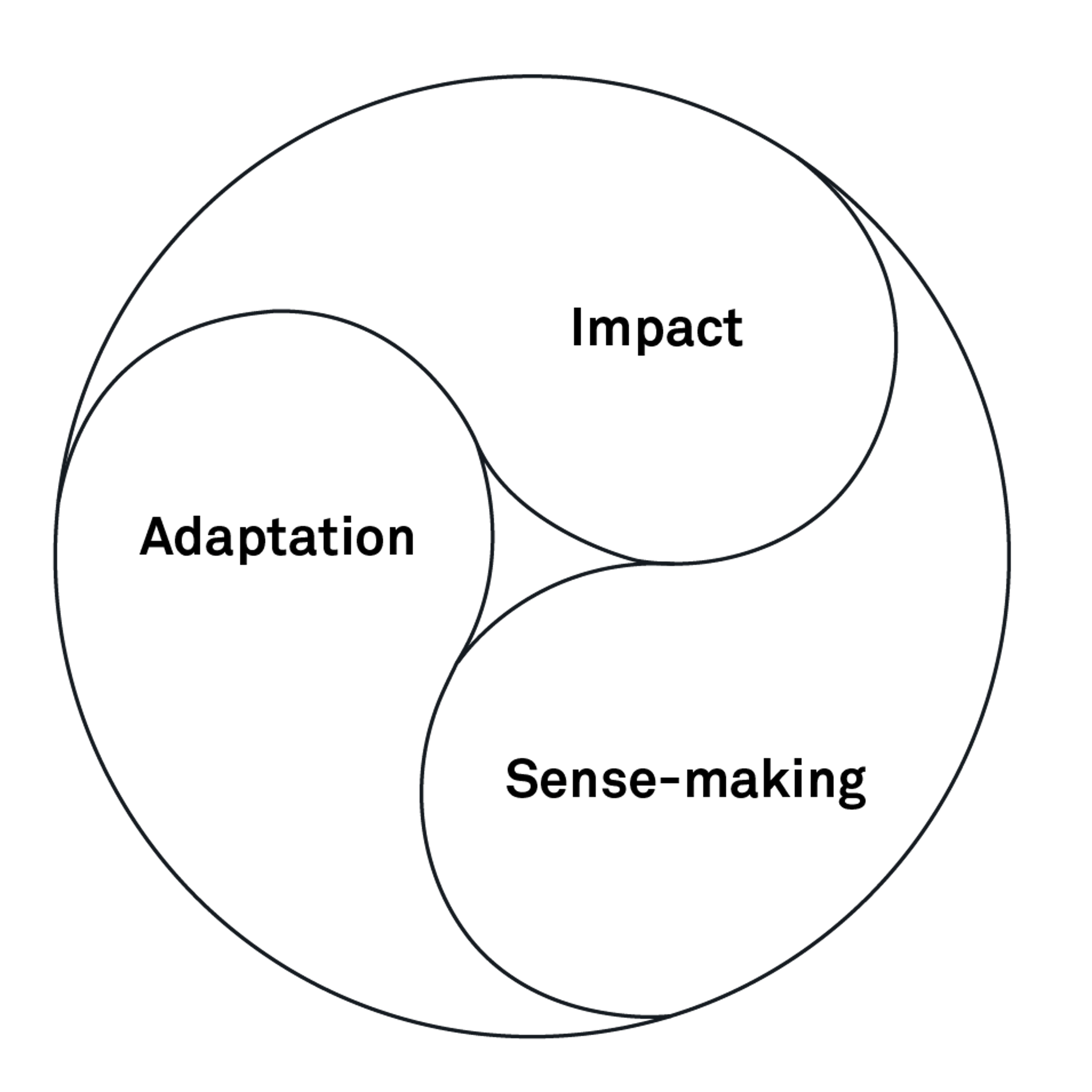
Building on the systemic lens articulated above, this article suggests a leadership cadence for attention that operationalises the systemic lens by specifying where leadership attention should be placed and how it should shift as reality unfolds. The premise is straightforward yet demanding: strategy only matters when customers can feel the difference. But in complex organisations, that difference does not emerge from execution alone. It emerges when leaders sustain parallel attention to three interdependent domains – impact, sense-making, and adaptation – so that outcomes, meaning, and ways of working evolve together rather than drifting apart.
The ISA leadership cadence is adaptive by design: change leaders place attention across all domains in parallel, adjust emphasis based on feedback, and make timely choices to navigate change forward. Rather than prescribing a sequence of steps, the ISA leadership cadence offers an integrative cadence for directing attention and decision-making; in doing so, it turns abstract intent into lived experience by keeping outcomes, meaning, and ways of working in productive coevolution. Thus, ISA is a simple leadership cadence that helps executives decide where to place attention week by week, day by day.
The leadership cadence holds three domains that leaders balance in context: impact functions as the anchor toward customer-felt outcomes; sense-making aligns purpose, context, and contribution; and adaptation embeds the new way of working by tuning the organisational system. These domains coevolve; attention cycles among them based on evidence, never as a fixed sequence but as an integrated practice.
Impact is the guiding star of transformation, orienting attention to realised return on investment and impact that customers and stakeholders can tangibly experience: better service, simpler journeys, clearer value. Its purpose is to keep the centre of gravity outside the organisation’s activity system and squarely on external validity, so success is judged by the felt difference at the frontline rather than by internal completion metrics. Designing from external outcomes backwards ensures that strategic intent is translated into benefits that are meaningful to customers and stakeholders, anchoring execution in measurable effects rather than abstract aspirations.
Practically, attention to impact requires that leaders link every activity, decision, and deliverable to a specific benefit, tracing the causal pathway from capability and process changes to observable outcomes in the customer journey. Because interventions propagate through structures and behaviours, leaders must continuously sense ripple effects – positive and negative – across the system and recalibrate realised benefits so effort remains aligned with what matters most externally. This discipline is outward-facing and context-attuned: conversations are oriented toward business, stakeholder, and societal value rather than toward individual advantage; initiatives are explicitly anchored in broader strategic goals and local conditions; and objectives are made measurable to drive behavioural alignment and track progress credibly. In practice, this looks like gauging all initiatives against impact, reading signals continuously to detect drift, and re-scoping work when evidence shows limited customer benefit, thereby sustaining momentum toward the outcomes that count.
Sense-making exists to create shared meaning and context as a collective act, so people across teams and geographies move together on the strategy, stay engaged through the messy middle, and reinforce impact over time. Its purpose is to align how the transformation is understood: why it matters, why now, and what it asks of each role, recognising that coherence is not given but authored socially through ongoing conversation. When sense-making is sustained, the organisation preserves a common narrative that ties individual contribution to collective purpose and progress, enabling followership and resilience as conditions evolve. Sense-making can be understood as collective second-order observation: the organisation observes how it understands itself, its context, and the meaning of the transformation, and adjusts actions accordingly.7
In practice, attention to sense-making must be early and continuous: leaders link collective purpose to each role, making the strategic journey legible and relevant for all, and actively shape the mental context by facilitating conversations about purpose, progress, and contribution. An outside-in perspective is essential; employees do not know what leaders know about objectives, strategy, or the aggregated impact of collective effort, so impact must remain at the core of what leaders do and say. This calls for a focused communication strategy that engages stakeholders on context, impact, and strategic objectives; integrative conversations that build trust and reinforce engagement within organisational realities; and stakeholder involvement early and continuously to cultivate real commitment and shared ownership.
Critically, action and meaning go hand in hand: people often come to understand through doing, so leaders must create opportunities for lived experience – trying new practices, reflecting on results, and re-authoring the shared story in light of evidence. In practice, this looks like establishing dialogue cadences that invite contribution, acknowledge tensions, and update frames as the environment shifts, thereby keeping the social authorisation of the change strong through the messy middle.
Adaptation ensures the organisation operates reliably as conditions shift by making processes, structures, culture, and behaviours adaptive by design. Its purpose is to embed the new way of working in the system so that desired practices integrate more easily and persist at scale, not as one-off acts of individual compliance but as sustained lenses supported by the environment. In this framing, adaptation is not an afterthought; it is the organisation’s capacity to reconfigure without losing performance, so the organisation remains fit for context as it evolves.
Practically, attention to adaptation means tuning the system, not merely onboarding individuals, through incremental adjustments to procedures, incentives, roles, and norms that create an environment where new behaviours are both easy and attractive to enact. Leaders afford and support relevant actions by designing contextual ‘pull’ toward desired behaviours, recognising that adoption works two ways: we shape behaviour to fit new structures and processes and we design contexts that reduce cognitive load, clarify affordances, and invite engagement. Acting as cultural architects, leaders align training, structures, and communication to reinforce the desired culture, ensuring that changes are coherent with organisational context and strategic goals. Structures and metrics are adjusted to foster behaviours that matter, using behavioural indicators (KBIs) alongside business metrics (KPIs) to assess, learn, and reinforce new practices.
Finally, adaptation depends on change capacity: equipping leaders and employees to lead and navigate change in the flow of work, so enablement and a learning culture make the organisation ready for ongoing shifts. In practice, this looks like iteratively refining decision rights, workflow interfaces, and reinforcement mechanisms while building local capacity to sense and respond, thereby making the new way of working reliable under variability.
The suggested ISA leadership cadence turns the systemic thinking mode for change into action. It is the cadence that keeps attention balanced across impact, sense-making, and adaptation so change is navigated successfully and impact persists over time. Yet cadence alone does not move an organisation; leadership does.
The effectiveness of the ISA leadership cadence depends on leaders who can read the nature of change, place attention deliberately, and make timely choices that ripple through organisational systems. Therefore, we turn next to the role of the leader, the capacities that make this cadence reliable, and the tensions leaders must navigate to protect momentum and impact when working with complex change in a BANI world.
Grounded in this systemic thinking mode for change, the leadership task is twofold.
As Deborah Rowland observes, “The biggest leadership challenge today is not to build the grand plan for the future but to create the capacity for ongoing change and innovation.” 8 This perspective underscores the imperative to cultivate leadership’s change capacity, embracing complexity and adapting to the evolving dynamics of the organisational environment.
In environments where customers, technologies, and regulations move faster than roadmaps, plans date quickly; capacity does not.
Capacity is the organisation’s lived potential in action, shaped by energy and resources, stretched by context, and transformed through practice. It is what enables leaders and teams to keep meaning aligned, tune ways of working, and deliver relevant outcomes as conditions shift.
Grounded in the systemic thinking mode, this article suggests six change capacities that leaders must cultivate to drive successful change under ever-changing conditions. The article unfolds three inner capacities, focusing on how leaders think in change and complexity, and three outer capacities, focusing on how leaders act in the flow of work, oriented to the macro, meso, and micro systems constituting organisational life. The purpose is pragmatic: to cultivate the ability to sense, interpret, decide, and adapt at pace, so strategic intent reliably becomes business impact.
These six capacities operate in concert. Inner capacities organise attention, frame choices, and hold complexity productively. Outer capacities create movement, social authorisation, and timely decision-making. Practiced together, they reduce friction, protect momentum, and help the organisation reconfigure without losing performance.
Systemic intelligence: seeing interdependencies before they become constraints
Systemic intelligence is the inner capacity to see the whole system and think with it. Leaders recognise interdependencies, tensions, and constraints across structures, incentives, relationships, and culture, and they anticipate second-order effects (the indirect and often unintended consequences that emerge as changes ripple through the system over time) as interventions propagate through formal and informal networks. Crucially, systemic intelligence involves holding multiple opposing ideas at once and combining the best of them for better solutions, resisting either-or choices that create local optimisation at the expense of enterprise outcomes. By expecting emergence, reading weak and strong signals, and designing with ripple effects in mind, leaders diagnose more accurately and keep change aligned across the different systems.
Strategic thinking: translating strategic intent into actionable priorities
Strategic thinking is the inner capacity to keep an unbroken line of sight from intent to impact. Leaders link strategy to the desired change and translate it into clear, consequential choices, guardrails, and priorities that people can enact. They tie behaviours to real business outcomes that customers will feel, work backward from those outcomes to the enabling capabilities and processes, and make trade-offs explicit so effort accrues to value, not activity. Strategic thinking is therefore a living practice, not a static plan; it keeps conversations outward-facing and anchored in measurable effects.
Adaptive thinking: integrating competing demands without losing momentum
Adaptive thinking is the inner capacity to adjust course as context shifts without collapsing into simplistic either-or choices. Rather than choosing between stability and change, speed and quality, or centralisation and autonomy, leaders practice adaptive thinking: they explore opposing options, examine the assumptions behind them, and design responses that combine their strengths. In this sense, plans are treated as hypotheses, not commitments. Leaders update direction and cadence based on evidence, learning, and shifting conditions, while preserving strategic coherence. Through short cycles of experimentation and reflection, uncertainty is converted into knowledge, enabling the organisation to remain both relevant and reliable as it evolves.
Sensing: reading and integrating small signals in the system
Sensing is the outer capacity to read the room and the system in real time. Leaders tune into underlying dynamics, noticing where energy accumulates and where friction persists, and they treat emotions and sentiment as data and input, not noise. Leaders prioritise presence with teams and customers providing timely feedback on how change actually lands, which enables recalibration of priorities and pace. Sensing blends analysis with grounded experience, turning abstract frames into situated understanding and improving the timing and targeting of change efforts and interventions.
Sense-making: building collective meaning as context shifts
Sense-making is the outer capacity to construct a shared story that aligns people to purpose and context. Leaders frame the objective and path meaningfully, help employees understand why, what, and how, and then keep the story alive as context evolves. Because change is socially constructed, authorisation of new behaviours arises in conversation, not documents, so sense-making pairs communication with conversation and links collective purpose to role-level contribution. Leaders facilitate action and meaning that reinforce each other, identify opportunities to try new practices that generate experience that is reflected upon and woven back into the shared narrative, sustaining engagement and followership through the messy middle.
Choice-making: making timely choices under uncertainty-making
Choice-making is the outer capacity to turn attention into movement by deciding with context at the right moment. Leaders make timely choices that align with strategy, sense and integrate the ripple effects, and accept trade-offs transparently. They establish clear decision rights and escalation paths, integrate quantitative indicators with qualitative cues, and commit to the next useful step within agreed guardrails and with risk-awareness. By reducing decision latency and clarifying rationale, choice-making protects momentum and builds trust, ensuring that progress accrues to customer-felt outcomes rather than to internal activity.
Together, these six capacities form a practical architecture for leading change that endures as reality shifts. Inner and outer capacities coevolve, thinking shapes action, action reshapes thinking, and both remain oriented to external validity. Capacity building is not training at the end; it is practice in the flow of work, short cycles, reflective routines, and targeted tools that make adaptability a property of the system. With this foundation in place, leaders are equipped to hold tensions productively and to focus their attention on impact, sense-making, and adaptation to lead complex change successfully.
In complex transformations, momentum rarely stalls because the plan is unclear, but because legitimate priorities pull against one another and leaders try to eliminate these tensions rather than balance them.
Tensions are persistent features of large-scale transformation; they arise from the need to be both reliable and relevant, fast and careful, centralised and contextual. The leadership task is to observe and name these tensions, hold both sides as valid, and make timely choices that keep the organisation within the corridor of strategy while adjusting route and cadence as conditions evolve.9
What follows are seven recurring tensions that significantly influence complex change.
The performance tension: developing the business and driving the business
Transformation requires investment in future capabilities while sustaining current performance. If development dominates, near-term results slip and stakeholder confidence erodes; if the operational side dominates, the organisation becomes trapped in incrementalism.
Leaders balance this tension by sequencing investments, setting operational guardrails, and proving value in short cycles, so today’s performance remains credible while tomorrow’s capabilities are built.
Example: A global manufacturer implementing a new ERP system phased process redesign and module rollout around peak seasons, protected critical operations with shadow capacity, and validated value in short waves that improved on-time delivery while building future capabilities. The company developed the business while maintaining operational reliability.
The purpose tension: organisational purpose and individual goals
Enterprise purpose mobilises collective movement; individual goals motivate local performance. When these are disconnected, engagement fragments and followership weakens.
Leaders balance this tension by continuously translating enterprise purpose into role-level contribution. They show how personal objectives serve the core task and how progress ladders up to customer-felt impact, thereby aligning enterprise aspiration with individual accountability.
Example: A retail bank undergoing a cultural transformation made customer trust and simplicity its central purpose and realigned branch incentives from cross-sell volume to journey quality and first-contact resolution. By linking individual targets to customer experience, the bank aligned local performance with its enterprise promise.
The strategy tension: staying relevant and maintaining stability
Strategy must evolve to remain relevant, yet stability is required for people to perform and enact the strategy. If relevance dominates, change fatigue and churn erode trust; if stability dominates, strategic drift sets in.
Leaders balance this tension by making explicit what is fixed and what is flexible. They update strategic frames at a pace the system can absorb and stabilise routines and interfaces where reliability matters most.
Example: During a merger integration, a mid-sized retail company refreshed its market priorities and portfolio while freezing customer support processes and service interfaces for six months. This allowed the organisation to remain relevant to customers while preserving stability in core operations.
The action tension: call for action and call for reflection
Momentum depends on action, and the quality of action depends on reflection. All action with little reflection produces rework and shallow learning, while all reflection with little action produces latency and lost time.
Leaders balance this tension by establishing a cadence that pairs movement with meaning. They embed brief, regular pauses to sense and interpret, then act with clarity on the next useful step.
Example: In the middle of a major reorganisation, a technology firm introduced fortnightly decision sprints to implement new reporting lines, followed by structured retrospectives to surface friction and refine roles. This cadence balanced rapid execution with collective learning.
The governance tension: central decision-making and local autonomy
Centralisation offers coherence and speed at scale, while local autonomy offers contextual fit and ownership. Overcentralisation breeds rigidity and disengagement; over-decentralisation breeds inconsistency and decision latency.
Leaders balance this tension by setting clear guardrails, decision rights, and escalation paths, allowing local adaptation within an enterprise frame that protects strategy and standards while building local ownership and anchoring.
Example: During an ERP rollout, a global pharmaceutical company defined non-negotiable global standards for data, controls, and process integrity, while mobilising local leaders to translate these into site-specific practices. By combining clear guardrails with local co-design, the organisation maintained coherence while building frontline ownership.
The judgement tension: following data and lived reality
Formal plans, targets, and performance metrics provide essential structure and coordination. Conversations, emotions, and frontline experience reveal how change is actually landing in practice. Overreliance on data and plans risks causing blind spots and delayed response; overreliance on sentiment and local signals risks drift and loss of coherence.
Leaders navigate this tension by treating numbers and narratives, plans and people, as complementary rather than competing inputs. They triangulate KPIs and operational milestones with qualitative feedback, sentiment, and lived experience, using the full signal to inform timing, prioritisation, and course correction. Rather than choosing between ‘following the plan’ and ‘following the people’, they continuously translate what the system is telling them into disciplined adjustments that preserve direction while improving fit with reality.
Example: A global manufacturer rolling out a new global brand launched a detailed plan for assets, retail guidelines, and campaign sequencing, supported by strong compliance metrics. At the same time, store-level conversations and distributor feedback revealed growing customer confusion about product naming. Leaders responded by convening rapid listening sessions, adjusting messaging hierarchies and in-store materials, and re-sequencing priority markets, preserving overall brand intent while improving fit with customer reality.
The ambition tension: planning the future and changing the now
Vision charts direction, small changes create movement. Leaders must balance the pull of long-range planning with the practice of changing what is directly in front of them, because even modest shifts in today’s routines, interfaces, and decisions generate ripple effects across relationships, systems, and future options. Overinvesting in distant plans detaches strategy from lived experience, overinvesting in isolated near-term fixes risks local optimisation without strategic lift. Effective leaders link micro-moves to macro-aims; they make tangible improvements now that are deliberately lensed to the future state – and they use evidence from these small wins to refine the longer arc.
Example: A division head leading a major transformation spent time on the shop floor and noticed that weak handovers between maintenance and production caused avoidable downtime. While future organisational design was still being developed, the leader introduced a simple handoff checklist and weekly joint reviews. Within weeks, stoppages declined, and the practice informed the emerging operating model.
Navigating these tensions is not ancillary to leadership in largescale change, it is the work. Plans can be delegated, tools can be standardised, but holding legitimate priorities in productive balance requires presence, judgement, and courage that only leadership can supply. When leaders name the tensions explicitly, listen deeply to signals from customers and teams, and make timely choices that honour both relevance and reliability, they protect the organisation’s scarcest resource – time – and convert activity into impact. Conversely, when tensions go unacknowledged or are forced into false either-or resolutions, rework, and decision latency follow, adoption decays, and ROI erodes. The leadership task is therefore continuous: sense where emphasis should shift, explain the trade-offs transparently, and adjust route and cadence without losing strategic intent. Done well, this praxis creates movement that holds, energy that sustains, and outcomes that customers can feel even in times of constant and complex change.
Large-scale transformations rarely fail because leaders lack ambition, intelligence, or effort. They fail because organisations apply linear logic to systems that are anything but linear. When change is treated as a sequence of activities to be managed alongside execution, momentum dissipates, adoption stalls, and expected returns never materialise. In complex environments, the problem is not insufficient planning; it is insufficient attention to how change actually unfolds in living systems.
The alternative is to lead change as a systemic capacity rather than as a temporary initiative. This means anchoring transformation in customer-felt impact, authorising new behaviours through continuous sense-making, and embedding those behaviours in system conditions that allow them to persist as context shifts. It requires leaders to build capacity rather than rely on plans, to read weak and strong signals in real time, and to make timely choices that hold competing priorities in productive balance.
For leaders, the implication is clear: stop asking whether the change plan is complete or the roadmap sufficiently detailed. Start asking whether the organisation has the capacity to sense, interpret, and adapt as reality unfolds.
In a BANI world – brittle, anxious, nonlinear, and incomprehensible – successful transformation is not delivered through better control but through better leadership attention. When leaders learn how to observe, where to look, what to balance, and how to act in context, strategy stops living on paper and begins to show up where it counts: in results that customers can feel.
1 Beer, M. & Nohria, N. (2000): Cracking the Code of Change. Harvard Business Review, May-June, 2000.
2 The CEO Report. Embracing the Paradoxes of Leadership and the Power of Doubt. SAID Business School and University of Oxford. Heidrick & Struggles, 2024.
3 Cascio J.(2025): Navigating the Age of Chaos: A Sense-Making Guide to a BANI World That Doesn’t Make Sense. Berrett-Koehler Publishers, October 28, 2025.
4 Luhmann, N. (1995): Social Systems. Stanford University Press.
5 Second order effects: The indirect, downstream consequences that emerge when an intervention propagates through an interconnected system, altering adjacent structures, incentives, norms, and behaviours beyond the intervention’s immediate, intended outcome (Meadows, D. H., 2008).
6 Heifetz, R. A., and Donald L. L., (1997): The Work of Leadership. Harvard Business Review, January–February 1997.
7 Luhmann, N. (2000): Organisation and Decision. Cambridge: Polity Press & Weick, K. E. (1995): Sensemaking in Organisations. Sage Publications.
8 Rowland, D. (2017): Still Moving: How to Lead Mindfully Through Change. Wiley, 2017.
9 Smith, W. K., & Lewis, M. W. (2011): Toward a theory of paradox: A dynamic equilibrium model of organizing. Academy of Management review, 381-403.
Cascio J.: Navigating the Age of Chaos: A Sense-Making Guide to a BANI World That Doesn’t Make Sense. Berrett-Koehler Publishers, October 28, 2025.
Lewis, M.: Paradoxes of Change and Changing through Paradox. Palgrave Handbook of Organizational Change Thinkers, 2nd edition, Palgrave Macmillan, 2020
Luhmann, N.: Social Systems. Stanford, CA: Stanford University Press, 1995
Luhmann, N.: Organisation and Decision. Cambridge: Polity Press, 2000
Meadows, D. H.: Thinking in Systems: A Primer. White River Junction, VT: Chelsea Green Publishing, 2008
Martin, Roger L.: The Opposable Mind: How Successful Leaders Win Through Integrative Thinking. Harvard Business School Press, 2007
Rowland, D.: Still Moving: How to Lead Mindfully Through Change. Wiley, 2017
Rowland, D: From Ought to Is: Catalysing Change and Movement in a Polarised World. John Wiley & Sons, 2025
Smith, Wendy K., and Lewis M.: Toward a Theory of Paradox: A Dynamic Equilibrium Model of Organizing. Academy of Management Review 36, no. 2, 2011
Weick, Karl E.: Sensemaking in Organisations. Thousand Oaks, CA: Sage Publications, 1995
Download Leading change when plans no longer work; A systemic lens on transformation in a BANI world.
Download here