Article
Why acquisition value is earned or lost through people and what senior leaders can do about it

Article
Read more
5 October 2026
A merger negotiates a shared future. An acquisition announces one. That single difference changes how the people side of a deal must be run, and it is why we treat acquisitions as their own discipline rather than a variation on merger integration.
In a merger of equals, structure, leadership, and ways of working are contested in the open. It is slow, but it is self-correcting: the hard questions get asked because both sides insist on asking them. In an acquisition, the buyer sets the terms – but carries all the risk that the target's knowledge simply walks out the door. And the capability you paid a premium for sits on the wrong side of that asymmetry.
Here is the pattern we see in acquisitions and almost never in mergers.
Decisions about how, when, and what to integrate are often neglected, because there is an underlying assumption that integration will follow the acquirer's operating model by default. This absence of active choice itself becomes a choice.
Nobody chooses the performance process, the grading structure, the approval thresholds or the leadership norms. They arrive by inertia, because the larger system keeps working and the smaller one stops. Call it integration by default. It can slow down progress, and it is expensive, because the properties you bought the company for are usually the first things the default dissolves.
If you acquired a business for its speed to market, its customer intimacy, or its engineering culture, those properties live in ways of working that your own governance will quietly overwrite – and it happens faster than you think. Nobody will be able to point to the decision that did it because there never was one single decision to point out.
Structure fails the opposite way, but just as reliably. Where the operating model drifts by inertia, the organisation chart gets decided very actively – by legacy hierarchy, rather than by the synergy the structure exists to deliver. One failure is passive and the other is political. Both produce an organisation that nobody designed against the value case. So, the first question in an acquisition is what you are deliberately choosing not to absorb and who holds the mandate to protect it when the default pushes back.
In most acquisitions, a disproportionate share of the synergy case rests on a small number of people: the ones who hold the customer relationships, the technical knowledge, or the market access that justified the premium. You can acquire a company. You cannot acquire the people inside it. They have to be re-recruited against a market that now knows exactly who they are – and that they are unsettled.
The pattern is measurable, and it runs wider than retention alone.
A four-decade study of 40,000 acquisitions found that 70–75% fail to meet the strategic, operational, or financial goals they were built on.1 Much of that gap opens before day one: fewer than one in five HR leaders say they were genuinely involved in early deal negotiations, and most describe themselves as underprepared for the deal already in front of them. The same pattern holds after closing – cultural misalignment is the most commonly cited integration obstacle, and roughly 40% of the critical talent an acquirer paid for is gone within 18–24 months.2 Retention below the leadership tier is rated integration's leading success measure and practitioners rank retention of key talent and managers 3.6 out of 4 in importance.3 Integration capacity is not overhead on the deal. It is part of the price of the asset.
The synergy case is priced at bid stage, usually before anyone has tested whether the organisation can carry it. And the moment the bid goes in, the incentive changes: the deal team moves from testing the number to defending it.
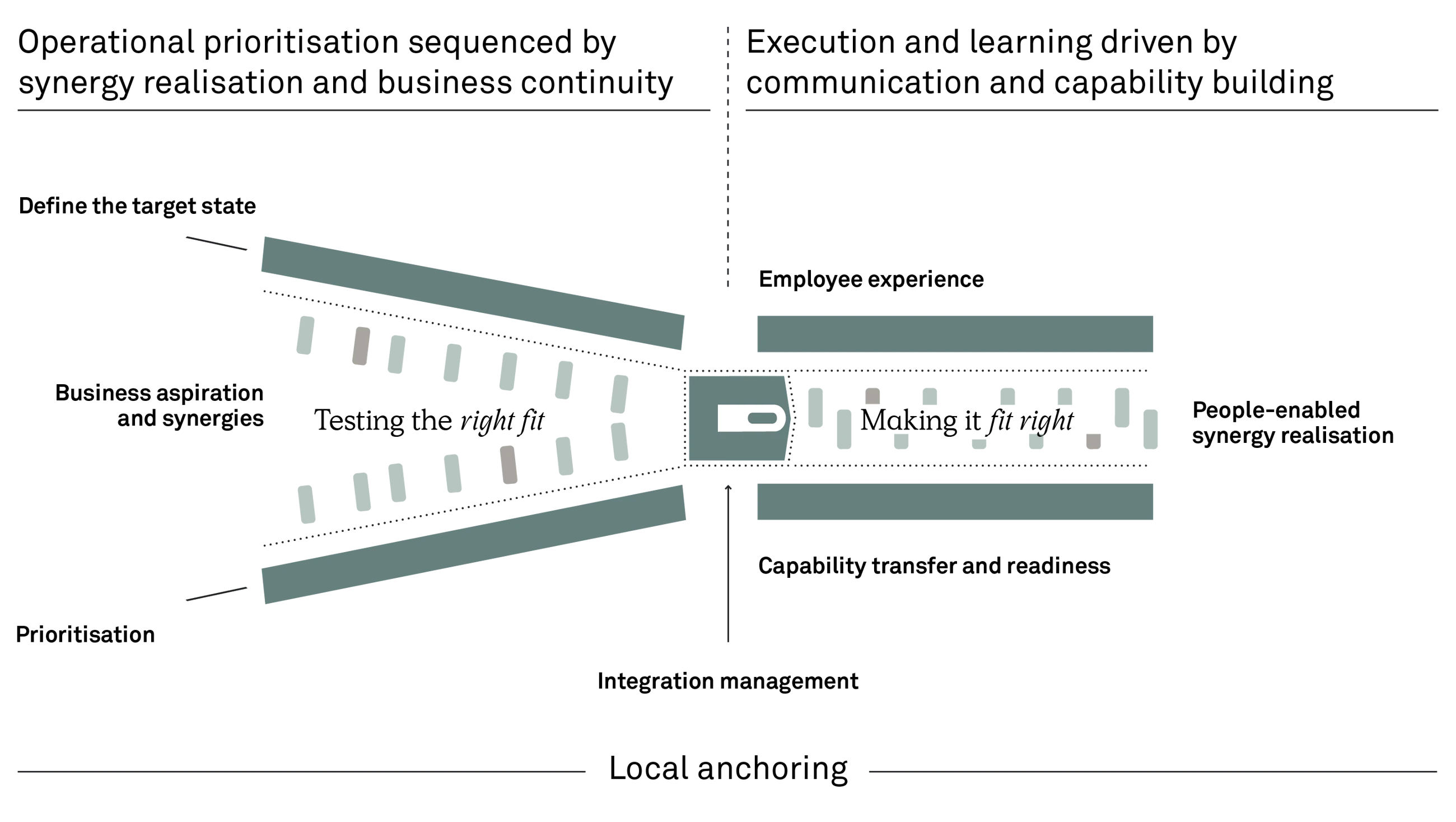
That is why the people and organisation view belongs in the room early, with one clear job: to break the case before it breaks the deal. Four questions matter most, and all four need answers before signing:
A case that survives those four questions is a solid business case and makes up the beginning of a plan. A case that does not meet them is merely a hope with a price attached.
Testing will surface more problems than you can fix at once, and they should not all be fixed at once. Sequence the work by what genuinely cannot slip on day 1, what carries the most value, and what threatens continuity if it fails. In an acquisition, the binding constraint is rarely the plan but the number of hard decisions the same small group of leaders can make in a week. A short list executed in the right order beats a complete one executed in parallel.
An acquisition changes the organisation people work in, but that does not mean it changes how they think or perform within it. The people being asked to adopt a new future had no hand in designing it and usually learned of it only after it was decided.
People rarely resist change itself. They resist ambiguity: about what is changing, why it matters, and what it means for them. People can adapt to a new reality but they cannot easily adapt to an unknown one.
So, adoption rests on two conditions that look identical in a status report and demand opposite responses. The first is willingness – whether employees and their managers have the clarity, trust, and credible leadership to commit to the new organisation. The second is readiness – whether they can actually operate in it: the systems, processes, decision rights, and skills the target state assumes. A workforce that is willing but not ready will fail quietly and look engaged while doing it. A workforce that is ready but not willing will comply and deliver nothing beyond compliance. The challenge is to diagnose which one you have before you decide to spend on either.
Acquisitions are confidential, so the integration team is usually drawn from the small circle already inside the deal. It gets selected for clearance rather than for capability, and seniority quietly becomes the proxy for competence, due to the sensitive nature of the project.
Map the capabilities the integration actually requires against the initiatives you have committed to, and staff against that as opposed to against hierarchy or availability. Then make ownership explicit: who decides, who delivers, and who is accountable for the value, named individually. In an integration, ambiguous ownership is the most expensive form of politeness.
And place the people workstream in the same room as the others. Almost every people decision in an acquisition carries a dependency: payroll needs finance, systems and access need IT, the organisation chart needs the business plan it exists to serve. Those dependencies surface either in the planning or in the week before day 1 – and only one of those is cheap.
Plan before day 1. Act inside the first 30 days, rather than the first 180. The choices that protect acquisition value – what you preserve, who you keep, what you harmonise, and in what order – all have to be made while the organisation still expects change. Wait, and you are no longer designing an organisation; you are renegotiating one that has already settled.
Most integration teams have a long list of activities. The question worth asking is narrower: Have we defined the activities that actually protect and deliver the value we paid for – and are we set up to execute them before the window of opportunity closes?
An acquisition is one of the few moments when an organisation’s future is genuinely rewritten. The financial logic gets the deal signed. The people choices decide whether it was worth signing.