Article

Published
7 September 2026
Future outlook
Whatever the future holds, one thing is clear: AI is no longer a question of if or when – the real question now is whether retailers have the trusted information, leadership, and workforce readiness to use it well. AI agents have already started to mediate between shopper intent and retailer assortment, and that change is happening now.
Across grocery retail, organisations are moving in a common direction. Not because the destination is clear, but because standing still is no longer an option. The early leaders do not have perfect roadmaps, but they take AI seriously, invest early despite thin margins, and stay curious and experimental rather than waiting for a fully-sanctioned plan.
In the near term, progress starts with pragmatic use cases that double as entry points for building data foundations and governance. The harder work lies inside the organisation: reconciling fragmented owner-operator and franchise data flows, bridging in-store hardware to enterprise data, and deciding who actually owns AI before shadow AI decides it for them.
At Implement, we see early leaders investing in the technology, yes, but also in data foundations, the activation of loyalty and transaction data already being collected, validated in-store environments, and, most importantly, organisational learning. Lasting impact will depend on retailers' ability to bridge the widening gap between frontrunners and the rest, and to unlock the value sitting in their own data before AI-mediated shopping reshapes the storefront from the outside in.
AI will revolutionise how customers interact with retailers. It will be seismic. There have been waves of technology disruption historically. We are on the cusp of another one with AI. AI will impact every facet of our business.
Ken Murphy, Group CEO, Tesco (UK)
The state of AI in grocery retail
Grocery retail is a large and important segment within the broader consumer goods and services sector. The business hinges on assortment and category management, executed through sourcing branded or private label goods from suppliers, across a supply chain that spans store operations and omnichannel fulfilment, marketing and loyalty, and customer service.
Three structural features shape how AI lands across all of them. Margins are generally thin (but volumes high), so leadership demands a business case before committing resources. Operating models are split between owner-operated and franchise stores, fragmenting strategy, data flows, and tool choices. The channel remains predominantly physical, as online grocery is still relatively small in the Nordics. Within this mainly in-store model, fresh food is replenished multiple times a week, making short-cycle restocking a continuous operational rhythm rather than a periodic activity.
Against that backdrop, AI today is treated as an efficiency tool, but its larger impact will be on frontline roles, decision-making, workforce capability, and competitive advantage.
It is genuinely mature in pockets: live transport and picking optimisation, vendor-embedded forecasting from suppliers like Relex and Afresh, and dynamic pricing on electronic shelf labels, but thin across the wider store estate, where broader physical-store AI such as LIDAR shopper-flow tracking is only just being piloted. In category management, what AI can do to remove manual work and free up time for value-adding AI-augmented enhancements is still largely untapped.
Strategically, the industry leans hard towards buy and partner over build, runs predominantly centralised AI operating models with only early signs of distribution into business teams, and is divided on ambition. Large traditional retailers favour structured planning while smaller and pure-play e-commerce players experiment rapidly. The direction is roughly balanced between top-down and bottom-up, with a slight bottom-up tilt.
The near-term picture is defined by two pressures pulling in opposite directions: first, substantial loyalty and transaction data already sitting underused inside the larger grocery chains; and second, overloaded central AI teams, pushing business functions into 'shadow AI' to make progress on their own.
Grocery retail is adopting AI pragmatically, but thin margins, fragmented operations, and physical-store constraints are slowing it down
Current state of AI in the industry…
AI is already in production where the economics are clearest. Transport and picking optimisation runs live in distribution operations, vendor-embedded forecasting is delivering inside existing software suites, and dynamic shelf-edge pricing on electronic shelf labels is the most visible in-store deployment today. Because the default capability strategy is buy/partner, retailers can adopt proven modules without standing up large in-house teams, and the falling cost of AI tooling is lowering the entry barrier far enough that smaller players can experiment too.
The industry is also sitting on a genuine asset. Larger grocery chains hold extensive loyalty-card and transaction data on shopping behaviour – data that remains largely underused and represents one of the clearest near-term margin levers available.
… but what is hindering adoption?
The hardest blockers are organisational, not technical: fragmented data, unclear ownership, limited governance, and insufficient workforce readiness.
Fragmented owner-operated vs. franchise operating models pull strategic focus, data flows, priorities, and tool choices apart, which makes any enterprise-wide rollout difficult. Physical-store hardware cannot be refreshed at software speed, producing a digital/physical backlog gap that throttles in-store ambition regardless of how ready the software is. And thin margins force slow, structured planning, compounded by vendor lock-in fear and a 2–4 years build-and-burn payback constraint that makes CIOs and CDOs hesitate on platform choice.
Underneath that, governance is lagging demand. Overloaded central AI teams are spawning shadow AI as colleagues act independently without oversight. Ownership of AI is unclear, with many organisations still waiting for the sanctioned AI strategy before moving, and data-quality and master-data issues remain a persistent barrier to deployment.


Future look of AI across grocery retail: AI, employees, and leaders working together
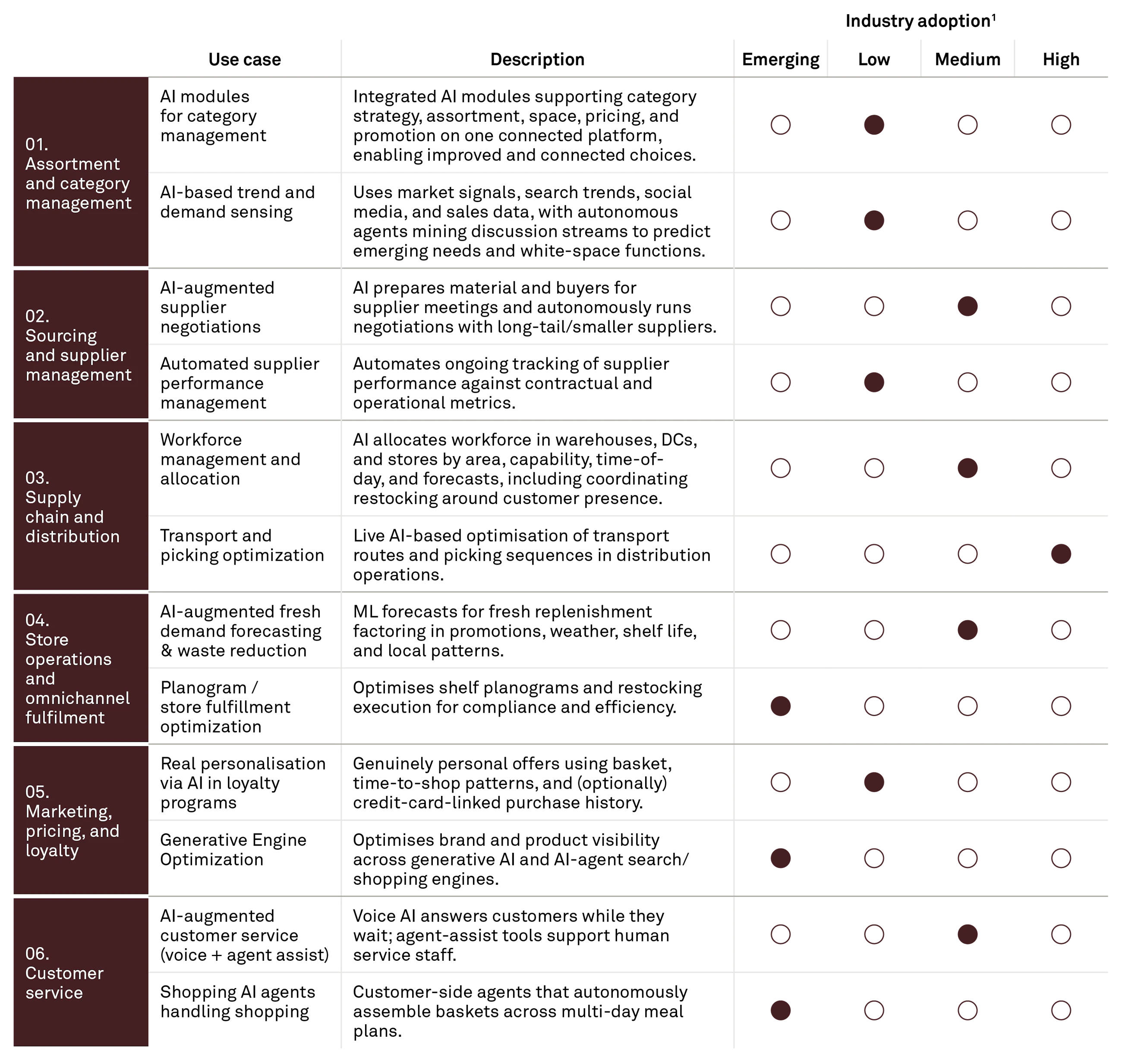
Highlighted future AI use cases in grocery retail

Reference cases
Implement reference cases
The two cases illustrate how Implement Consulting Group has embedded AI into core business processes with clients, delivering tangible results and meaningful business impact.
Optimising dark-store logistics for an FMCG client
Network optimisation // Geospatial analytics
A client wanted an evidence-based way to decide where to place a network of ‘dark stores’, local micro-warehouses enabling fast last-mile delivery to a wide base of customers. Using existing client data and modelling the Danish road network as a mathematical graph, we calculated delivery travel times from different starting points to determine optimal store placement, achievable geographic reach, and the investment required to launch.
Impact
- Simulated delivery reach and the share of existing clients served within target time windows
- Quantified how many stores and delivery staff were needed to hit coverage goals
- Delivered a feasibility assessment and a first-step roadmap to initialise the concept
Increasing visibility across AI search engines with GEO
Generative AI // Brand visibility
A global pharmaceutical company saw a visible gap in how its products and narrative appeared in AI-generated search responses, as the authority sources these systems draw on did not consistently reflect its messaging. With customers increasingly using AI search to research and compare options, we helped the company shape accurate, current, and strategically aligned key messages across those sources to lift its visibility and preference.
Impact
- Scaled into 11 workstreams spanning multiple functions
- Engaged selected media outlets and leading authority sources to refine and disseminate key messages
- Early tracking shows AI search responses shifting towards the company's desired narrative
In our experience, grocery retailers must make explicit strategic choices to unlock the value of AI

The AI landscape
Traditional, generative, and agentic AI
Traditional artificial intelligence (AI) refers to machine learning and statistical models that use structured data to automate, predict, and optimise decision-making. These systems identify patterns and improve outcomes in areas such as demand forecasting, pricing, inventory management, and operational efficiency.
Generative AI (GenAI) extends these capabilities through large language models (LLMs) and generative architectures designed to handle inputs and outputs. GenAI can analyse and create content from unstructured data such as text, images, or audio, enabling interactive and context-aware retail applications. An assistant is an LLM configured through prompt engineering and access to business data to perform a specific task, such as answering customer questions or creating product descriptions.
Agentic AI systems give LLMs autonomy and access to predefined tools, allowing them to complete multi-step retail tasks such as checking stock, preparing replenishment orders, updating product information, coordinating promotions, and resolving customer-service requests.
Reach out to our experts0 3
0
3Related0 4
Article
Read more

AI in the energy industry
AI is scaling in trading, while most of the energy value chain is still at pilot stageArticle
Read more

Redesigning the digital operating model for the agentic AI era
The strategic choices CIOs must make to capture value from agents.Article
Read more

AI in shipping and logistics
In a high-pressure environment, AI is emerging not just as a support function, but as a strategic lever for resilience...Article
Read more